Jan. 17, 2011
An Egyptian man sets himself on fire outside Cairo's parliament building after a dispute with local authorities over receiving his monthly coupons for subsidized bread. This fast-food stand owner was apparently inspired by the Tunisian fruit seller whose self-immolation triggered a popular uprising in December 2010.
Jan. 18, 2011
An unemployed man in Alexandria is the second Egyptian to set himself ablaze in two days. He dies as a result of third-degree burns after setting fire to himself using fuel on the roof of his house.
Jan. 25, 2011
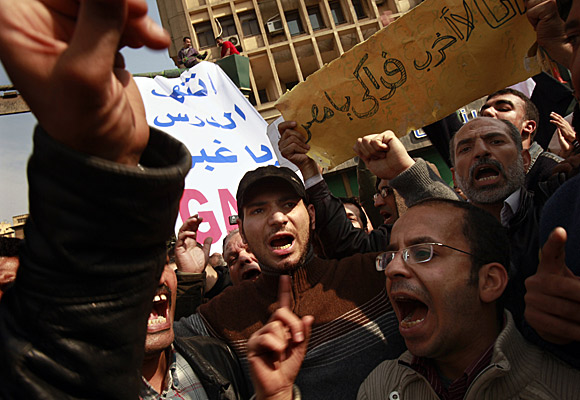
Protesters take to the streets of Cairo to demonstrate against political repression and unemployment under President Hosni Mubarak. Several thousand people clash with police on Egypt's "Day of Anger."
Jan. 27, 2011
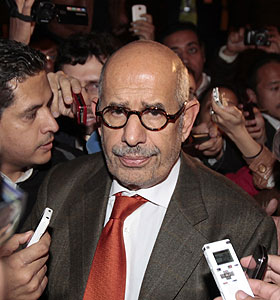
Opposition leader Mohamed ElBaradei, the Nobel Peace Prize laureate who formerly headed the U.N. nuclear regulatory agency, returns to Egypt. ElBaradei's presence energizes activists who for months had urged him to take his National Front for Change to the streets. His arrival coincides with a decision by the Muslim Brotherhood, the country's largest opposition group, to encourage its young members to join the protests.
(Lefteris Pitarakis / Associated Press)
Jan. 28, 2011
Government opposition leader and Nobel laureate Mohamed ElBaradei is placed under house arrest by police after joining tens of thousands of protesters in Cairo.
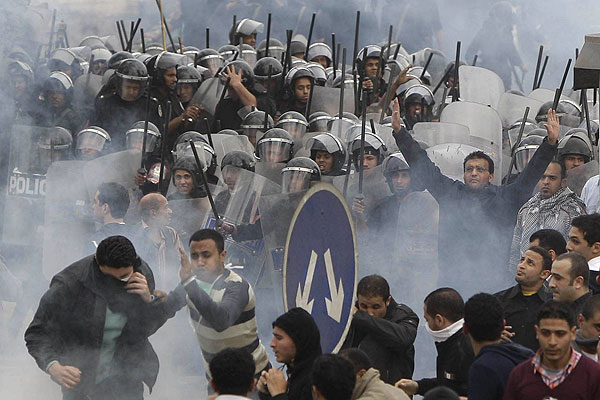
Protesters flee riot police amid plumes of tear gas in Cairo.
(Ben Curtis / Associated Press)
Jan. 29, 2011
Mubarak family
President Hosni Mubarak announces in a televised address that he will dismiss his cabinet and appoint a new government. However, he does not discuss the major reforms citizens called for regarding poverty, inflation and unemployment.
(Associated Press)
Jan. 29, 2011
Egyptian protesters defy a government-imposed curfew for a second night. Lawlessness spreads across Cairo as police back off from confrontations in most areas of the capital.
(Ben Curtis / Associated Press)
Jan. 30, 2011
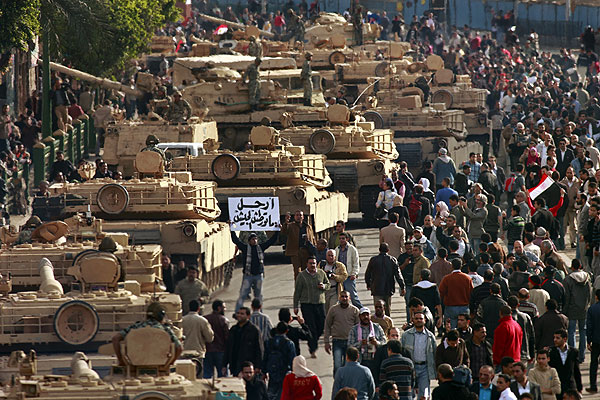
Egypt's military moves more aggressively to take control of parts of the capital, but the sixth day of unrest ends with increasing questions about how much longer President Hosni Mubarak can withstand calls for his resignation, including an electrifying demand from opposition leader Mohamed ElBaradei that he step down to "save the country."
The Egyptian Army has taken command of Cairo.
(Carolyn Cole / Los Angeles Times)
Jan. 31, 2011
Army officials recognize protests as "freedom of speech" and say they will not use force against demonstrators.
(Carolyn Cole/Los Angeles Times)
Feb. 1, 2011
Egypt's protest organizers call for 1 million compatriots to flood the streets of Cairo and brush aside the appointment of new government ministers as meaningless.
Feb. 1, 2011
Mubarak family
President Hosni Mubarak says he will not step down and vows to fulfill his term.
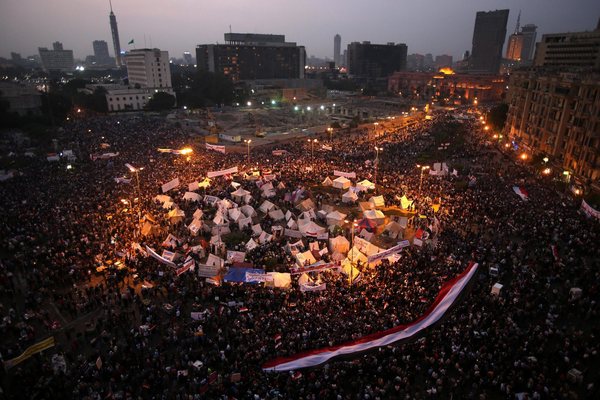
Hundreds of thousands of Egyptians gather in Liberation Square to call for the departure of President Hosni Mubarak.
(Carolyn Cole / Los Angeles Times)
Feb. 2, 2011
Clashes between Mubarak's supporters and anti-government demonstrators in Tahrir Square turn violent, with three people killed and more than 600 injured.
(Michael Robinson Chavez/Los Angeles Times)
Feb. 3, 2011
Mubarak family
President Hosni Mubarak says in an interview with ABC News that his resignation would create chaos and the risk of Islamic radicals' seizing control of Egypt.
Feb. 4, 2011
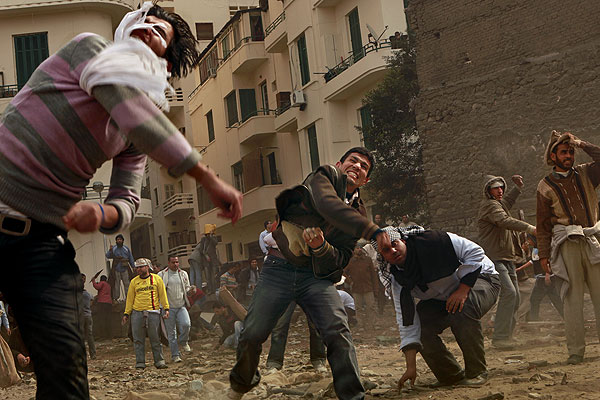
As the breakdown of law and order accelerates across Egypt's capital, anti-government protesters declare that the embattled president must step down by the end of the day.
Anti-Mubarak protesters throw rocks at rival group pro-Mubarak forces at the edge of Liberation Square.
(Carolyn Cole / Los Angeles Times)
Feb. 5, 2011
Mubarak family
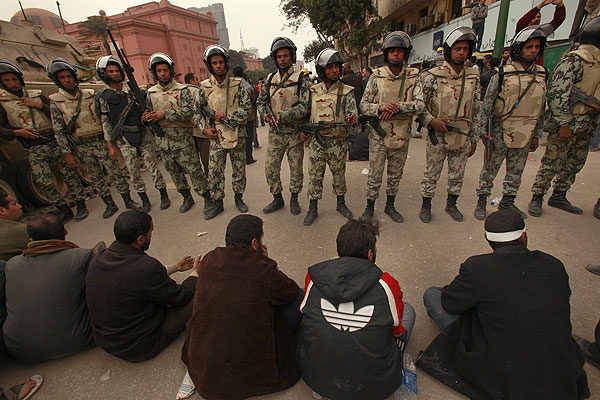
The leaders of Egypt's ruling National Democratic Party, including Hosni Mubarak's son, resign.
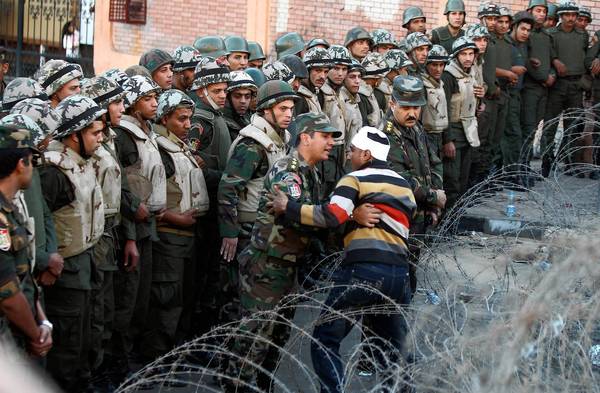
Troops and anti-Mubarak protesters face each other in downtown Cairo's Tahrir Square.
(Carolyn Cole / Los Angeles)
Feb. 6, 2011
Opposition groups, including the banned Muslim Brotherhood, hold landmark talks with Egypt's vice president. The two sides remain at apparent loggerheads over opponents' principal demand: that President Hosni Mubarak resign immediately.
(Soliman Oteifi / Associated Press)
Feb. 11, 2011
Mubarak family
President Hosni Mubarak resigns, handing power to the Egyptian military before fleeing Cairo. Demonstrators celebrate in Tahrir Square.
(Rick Loomi / Los Angeles Times)
Feb. 13, 2011
Egypt's military dissolves parliament and suspends the constitution, saying it will rule for six months or until presidential and parliamentary elections are held.
(Rick Loomis/Los Angeles Times)
Feb. 28, 2011
Mubarak family
Egypt's attorney general forbids Hosni Mubarak and his family from traveling and orders their financial assets frozen.
(Associated Press)
March 3, 2011
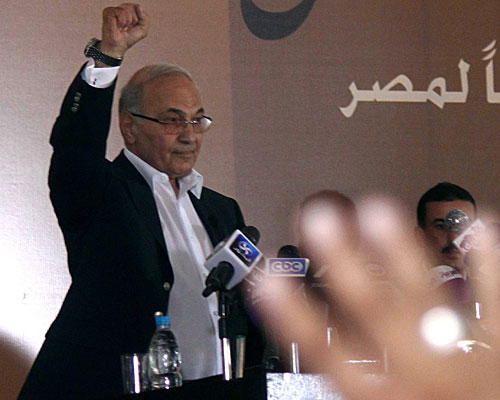
The beleaguered prime minister appointed by Hosni Mubarak resigns. The resignation of Ahmed Shafik, a former air force general and one of the most potent holdover symbols of the Mubarak regime, was announced on the ruling military council's website.
March 5, 2011
Thousands of protesters storm state security headquarters amid rumors that officials are trying to destroy documents that might incriminate the agency in abuse and torture.
(Wissam Nassar / AFP/Getty Images)
March 19, 2011
Egyptians head to the polls to vote on eight constitutional amendments designed by the military council to help the government's transition. The poll comes in advance of presidential and parliamentary elections also planned for this year.
(Aris Messinis / AFP/Getty Images)
March 20, 2011
A referendum calling for judicial oversight of elections and limited presidential terms passes with 77.2% of the vote. More than 18 million voters, about 41% of those eligible, cast ballots.
(Aris Messinis / AFP/Getty Images)
April 10, 2011
Mubarak family
Former Egyptian President Hosni Mubarak speaks out for the first time since his regime was toppled. He says he and his family are victims of a campaign by political enemies seeking to tarnish their reputation by exaggerating their wealth with false charges of corruption.
April 12, 2011
Mubarak family
Two days after Hosni Mubarak and his sons were summoned for questioning by authorities for alleged corruption and abuse of power, the former president is admitted to a hospital in Sharm El Sheikh.
(European Pressphoto Agency)
April 13, 2011
Mubarak family
Hosni Mubarak and his sons are detained for interrogation on allegations of corruption, abuse of power and other crimes, including deadly violence against protesters.
(AFP/Getty Images)
April 19, 2011
The Egyptian government's investigation into the nearly three-week-long revolution that overthrew President Hosni Mubarak paints a sinister portrait of a desperate police state relying on snipers, thugs and other forces that led to the deaths of at least 846 people.
(Michael Robinson Chavez / Los Angeles Times)
April 30, 2011
The Muslim Brotherhood, a popular Islamic movement long banned from politics by Hosni Mubarak, forms a political party.
May 13, 2011
Mubarak family
Shortly after former first lady Suzanne Mubarak was ordered detained as part of the widening corruption investigation of her husband's regime, she was hospitalized, reportedly after suffering a heart attack.
(Ali Haider / EPA)
May 17, 2011
Mubarak family
Egyptian state television announced that former first lady Suzanne Mubarak had been officially released after turning over $4 million in assets to the finance ministry, according to Assem Gohari, the head of the country's illicit-gains authority. Mubarak remains in a hospital, where she was taken after being informed of her possible imprisonment.
May 24, 2011
Mubarak family
Egypt will put Hosni Mubarak, its president for three decades, on trial in connection with the deaths of protesters during the uprising that forced him from office.
May 28, 2011
Mubarak family
A judge fines former President Hosni Mubarak and two officials about $91 million for cutting cellphone and Internet services during the protests this winter that forced Mubarak to step down.
June 26, 2011
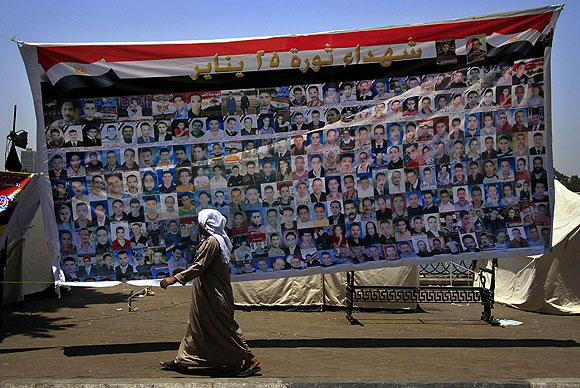
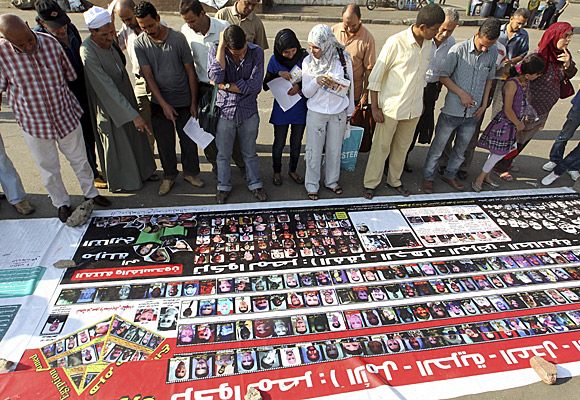
Egyptian police officer Mohamed Ibrahim Abdul Monem is sentenced in absentia for the Jan. 28 shooting deaths of 23 protesters rioting outside a Cairo police station.
A banner in Cairo labeled "Martyrs of the Jan. 25 Revolution" features pictures of protesters slain by Egyptian security forces during the uprising.
(Khalil Hamra / Associated Press)
June 27, 2011
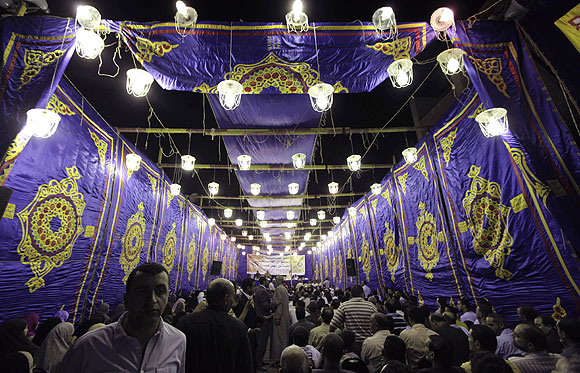
Opposition groups seek to postpone September elections amid fears that the more unified Muslim Brotherhood and members of the former regime will gain too much influence.
A Muslim Brotherhood electoral rally in the Munib neighborhood of Cairo.
(Nasser Nasser / Associated Press)
July 9, 2011
Tens of thousands of Egyptians protest for political reforms and swifter trials for police and former government officials charged with killing hundreds of demonstrators during the revolution that toppled President Hosni Mubarak.
July 13, 2011
Egypt fires more than 600 high-ranking police officers. The move comes on the same day the military council announces that parliamentary elections planned for September would be delayed until October or November.
In Cairo's Tahrir Square, a banner is displayed with photos of some of the people killed during the uprising in Egypt.
(Khaled Elfiqi / EPA)
July 29, 2011
A huge rally meant to symbolize Egyptian unity highlights instead the deepening splits between secularist and Islamist parties over the direction of a nation.
(Khalil Hamra / Associated Press)
Aug. 3, 2011
Mubarak family
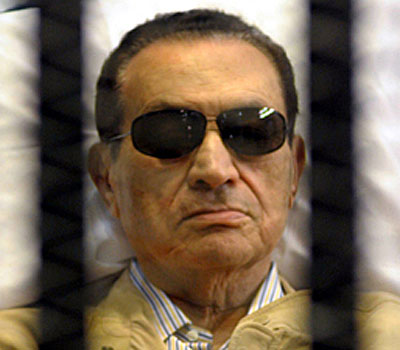
Flat on his back and flanked by two sons dressed in prison whites, former President Hosni Mubarak peers from his hospital bed through the bars and mesh of a cage and denies charges of corruption and abuse of power.
(Egyptian State Television)
Aug. 15, 2011
Judge Ahmed Refaat, who had grown exasperated with grandstanding by lawyers representing the families of victims allegedly gunned down by Hosni Mubarak's security forces, rules that television cameras will not be allowed in the courtroom when proceedings resume Sept. 5.
Sept. 5, 2011
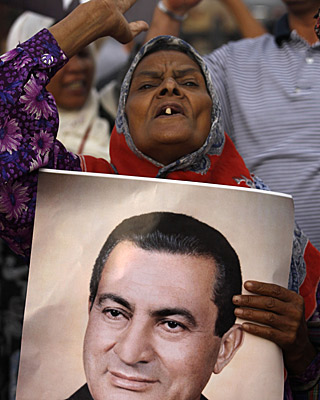
During a day of fistfights and raucous courtroom antics, a former senior state security official testifies that he knew of no orders to shoot protesters during the revolution that overthrew the Egyptian president.
A woman holds a portrait of Hosni Mubarak outside the court
(Dimitri Messinis / Associated Press)
Sept. 8, 2011
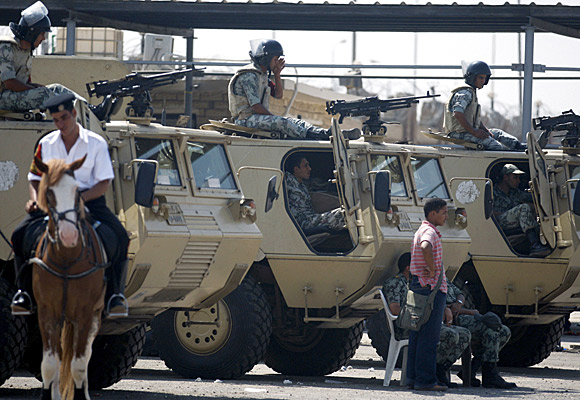
A former high-ranking security official testifies that forces loyal to Hosni Mubarak were ordered to use excessive force to crush protests in the early days of the revolution.
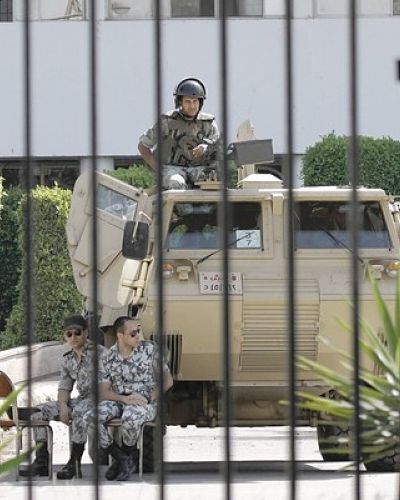
Soldiers stand guard at the court near Cairo where Hosni Mubarak and others are on trial.
(Khalil Hamra / Associated Press)
Sept. 15, 2011
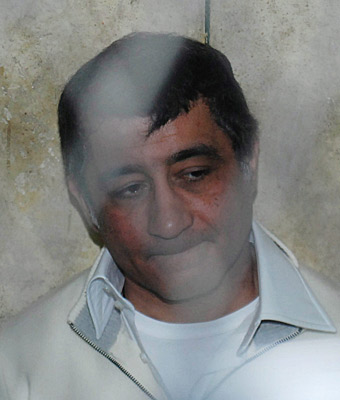
An Egyptian court sentences a steel magnate and a former top industries official to 10 years in prison each and fines them a combined $111 million on charges stemming from the corruption that defined the era of toppled President Hosni Mubarak.
The steel magnate, Ahmed Ezz, is sentenced to 10 years in prison and fined millions of dollars.
(EPA)
Sept. 17, 2011
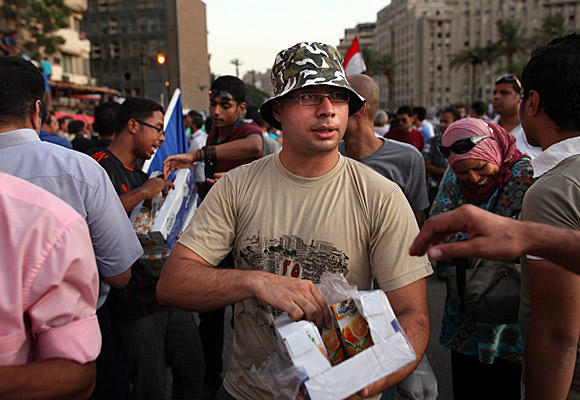
Ahmed Maher, leader of the April 6 Youth Movement, is one of the country's most savvy activists. But he senses the young are losing the revolution they heralded.
Ahmed Maher hands out juice to demonstrators in Cairo's Tahrir Square.
(Holly Pickett / For The Times)
Sept. 30, 2011
Thousands of protesters once again gather in the heart of Cairo to voice their exasperation with the ruling Supreme Council of Armed Forces. Protesters and political groups call for an end to emergency laws, amendments to the new elections law, a date for a presidential election, and a clear timeline for drafting a new constitution.
Oct. 9, 2011
In the bloodiest unrest since last winter's uprising, authorities said, three soldiers and 19 protesters were killed when Copts threw Molotov cocktails at riot police outside the state Radio and Television Building in downtown Cairo.
(Abdelhamid Eid / EPA)
Oct. 12, 2011
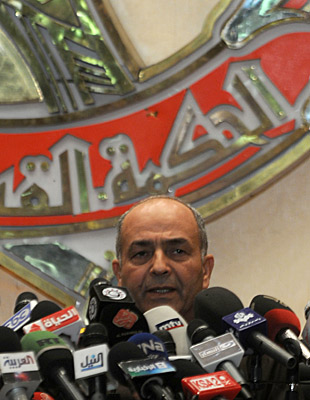
In an attempt to stem widening criticism of their grip on power, generals in Egypt's ruling Supreme Council of the Armed Forces said that soldiers were attacked by mobs and did not intentionally kill Coptic Christian protesters.
Gen. Mahmoud Hegazi at a news conference.
(Mohammed Hossam / AFP/Getty Images)
Nov. 3, 2011
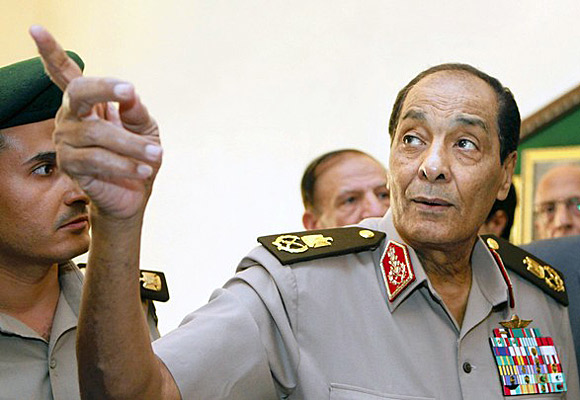
Activists and politicians worry that the military, Egypt's most revered institution before the revolution, refuses to have its authority and financial interests answerable to an emerging democracy.
Field Marshal Mohamed Hussein Tantawi is the head of Egypt's ruling military council.
(Amr Nabil / Pool Photo)
Nov. 20, 2011
Clashes erupt for the second day between police and protesters. Anger has been building over the unrealized promise of a revolution that ousted Hosni Mubarak but has yet to steer the country toward democracy.
(Mohamed Omar / EPA)
Nov. 21, 2011
As deadly clashes intensify between thousands of protesters and riot police, Egypt's interim government offers to resign in an attempt to calm three consecutive days of unrest that have shaken the country ahead of parliamentary elections.
(Khaled Desouki / AFP/Getty Images)
Nov. 23, 2011
Protests swell in Cairo for a sixth day as international pressure mounts on Egypt's military rulers to stop a deadly crackdown on demonstrators who have reinvigorated the defiant spirit that overthrew Hosni Mubarak.
Nov. 25, 2011
They came by the tens of thousands, swelling through neighborhoods, marching over bridges and pouring into Tahrir Square in the biggest protest yet against Egypt's increasingly isolated military rulers.
(Odd Andersen / AFP/Getty Images )
Nov. 28, 2011
Delays are met with determination as Egyptians vote in the first free elections since President Hosni Mubarak's fall.
Nov. 29, 2011
For a second day, throngs of Egyptians vote in parliamentary elections that are surprisingly peaceful, as the country appears determined to fulfill the so far elusive promises of the revolution that toppled Hosni Mubarak.
(Ahmed Ali / Associated Press)
Dec. 4, 2011
In the first round of parliamentary elections, Islamist parties win more than 60% of the vote.
Dec. 14, 2011
Egyptians take part in a second round of voting that is expected to boost Islamist parties' control over the soon-to-be-formed parliament.
Dec. 16, 2011
In the worst violence since the start of parliamentary voting last month, one person is killed and more than 130 people are hurt in a clash with pro-democracy protesters in downtown Cairo.
(Ahmed Ali / Associated Press)
Dec. 19, 2011
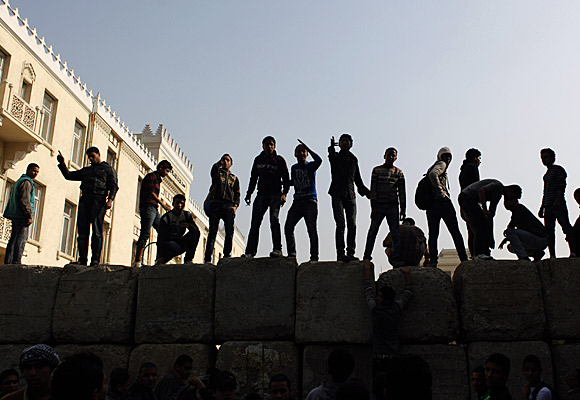
A fourth day of clashes in Cairo's Tahrir Square brings the death toll to 13 as Egypt's interim leaders defend their handling of the protests and demonstrators continue to call for the military to relinquish
its control of the government.
Protesters stand atop a barrier put up by the military to block a road near Tahrir Square in Cairo.
(Nasser Nasser / Associated Press)
Dec. 24, 2011
Islamist parties have solidified their lead in Egypt's historic parliamentary elections, capturing about 70% of the seats up for grabs in the second phase of a three-part poll.
Egyptian election officials count votes in front of a ballot box at a counting center in Giza.
(Amr Nabil / Associated Press)
Jan. 21, 2012
A new political era in Egypt begins as Islamist parties win nearly three-quarters of the seats in parliamentary elections to inherit a nation mired in economic crisis and desperate to move beyond military rule and the corrupt legacy of deposed President Hosni Mubarak.
Jan. 24, 2012
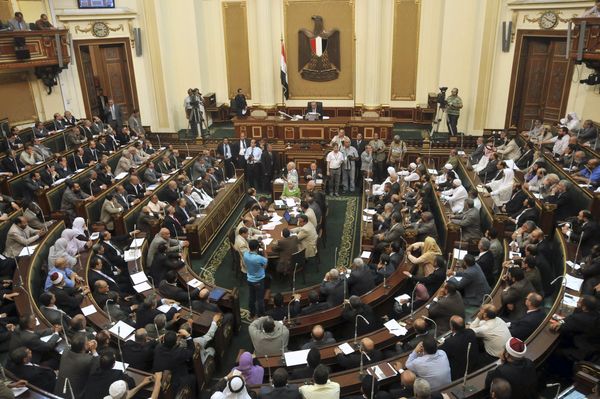
Egypt's new parliament holds its inaugural session, and a sense of wonder is mixed with the gravity of a country still under military rule and beset by economic turmoil.
April 14, 2012
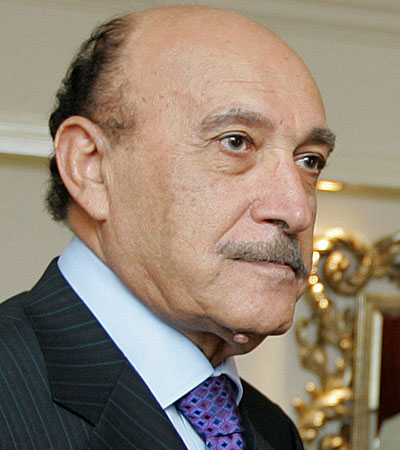
Egypt's volatile presidential race is jolted when the election commission disqualifies three controversial front-runners -- the nation's former spy chief and two impassioned Islamists -- just five weeks before voters go to the polls.
Egypt's former intelligence chief, Omar Suleiman, seen in 2009, was one of the three disqualified candidates.
(Tara Todras-Whitehill / Associated Press)
May 23, 2012
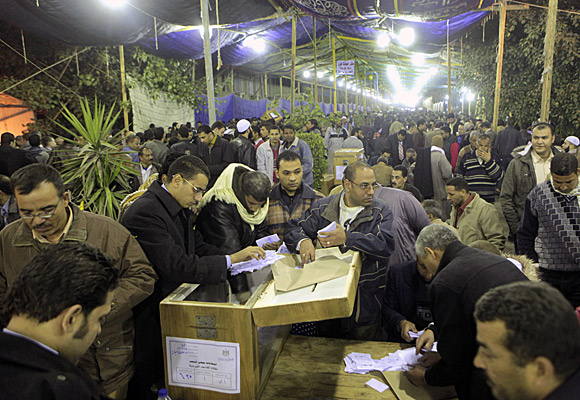
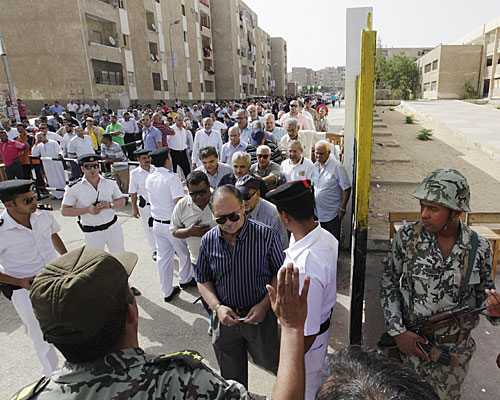
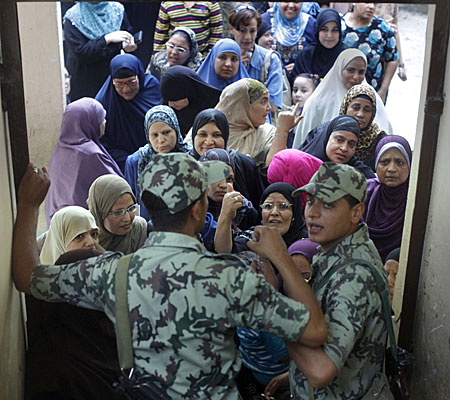
Egyptians begin two days of voting in a landmark contest between a stirring political Islam and a secularist vision embodied by men connected to the old regime.
Egyptian army soldiers stand guard as hundreds of Egyptians line up outside a polling station in Cairo.
(Amr Nabil / Associated Press)
June 2, 2012
Mubarak family
The life sentence imposed on toppled President Hosni Mubarak for complicity in the deaths of hundreds of protesters marks an unprecedented milestone in Egypt's path toward democracy.
Egyptians gather at Tahrir Square in Cairo to call for a new revolution in Egypt.
(Fredrik Persson / Associated Press)
June 14, 2012
The battle between Egypt's military leaders and the ascendant Muslim Brotherhood over the country's political fate dramatically sharpens when the nation's constitutional court dissolves the Islamist-dominated parliament while upholding the right of an ally of deposed leader Hosni Mubarak to remain on the presidential election ballot.
Egyptian presidential candidate Ahmed Shafik greets supporters at a news conference in Cairo.
(EPA)
June 18, 2012
The Muslim Brotherhood claims victory in Egypt's landmark presidential runoff election, but its historic rise to power is blunted by a decree from the ruling military council to greatly limit the authority of the nation's next leader.
Egyptian voters line up outside a polling center during the second day of the presidential runoff in Cairo.
(Amr Nabil / Associated Press)
June 19, 2012
Mubarak family
Egyptian officials deny reports that deposed President Hosni Mubarak was clinically dead after he suffered a stroke and slipped out of consciousness at a prison hospital in Cairo, according to state and independent news media. Conflicting reports about the former leader's health emerged after a report by the official state news agency MENA that Mubarak was declared "clinically dead" after he was transferred from a prison hospital to a nearby military hospital. The report could not be independently verified.
Egyptian officials denied reports that Hosni Mubarak is clinically dead
(EPA)
June 20, 2012
Conflicting reports about Hosni Mubarak's health leave Egypt confused and suspicious. His "near death" strikes many as just another political ploy.
Amr Nabil / Associated Press Photos / June 20, 2012
(Egyptian soldiers guard the military hospital where former President Hosni Mubarak was on life support.)
June 22, 2012
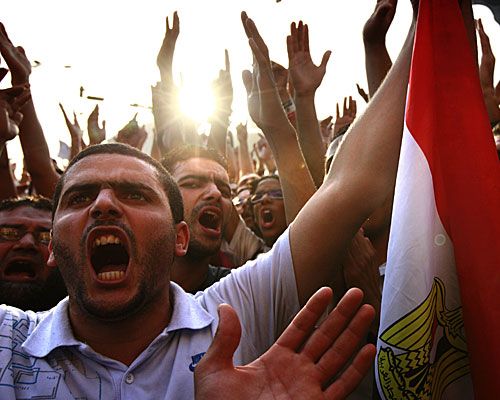
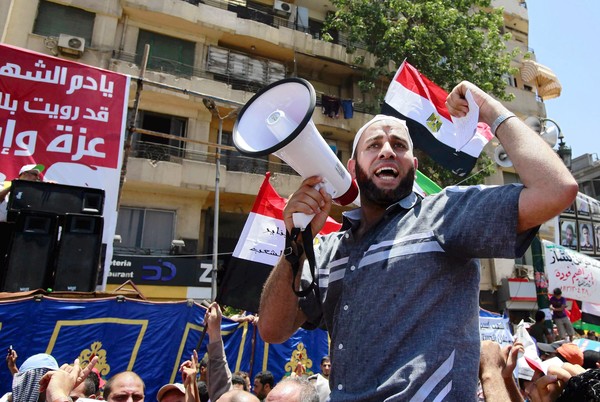
Protesters return en masse to Egypt's Tahrir Square as the Muslim Brotherhood and other groups stage a sit-in to protest actions by Egypt's military council ahead of presidential runoff results.
Andre Pain, European Pressphoto Agency / June 21, 2012
(A supporter of Egyptian presidential candidate Mohamed Morsi shouts slogans during a sit-in at Tahrir Square in Cairo.)
June 24, 2012
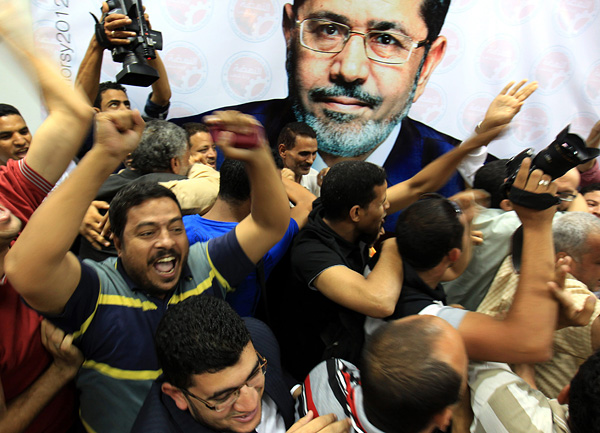
Muslim Brotherhood candidate Mohamed Morsi is declared Egypt’s first freely elected president, defeating Ahmed Shafik, the last prime minister to serve deposed leader Hosni Mubarak.
Members of the presidential election campaign of Muslim Brotherhood's Freedom and Justice Party candidate Mohamed Morsi, depicted in poster, celebrate upon the announcement of his victory in a historic election, at their headquarters in Cairo.
(Amel Pain / EPA)
June 26, 2012
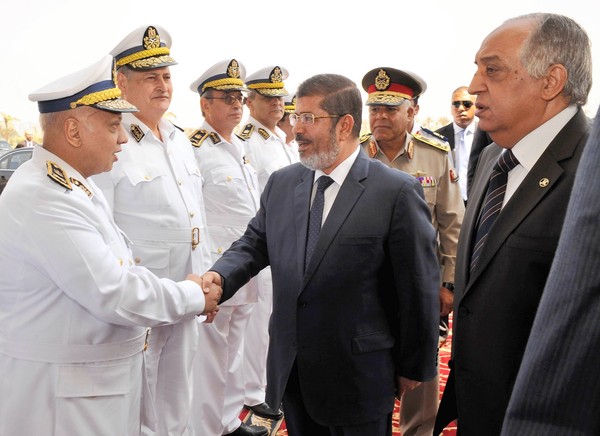
A move by Egypt's ruling generals to revive martial law is blunted as a court strikes down a government decree that had allowed soldiers and military intelligence services to arrest civilians during the nation's political turmoil.
President-elect Mohamed Morsi, accompanied by Interior Minister Mohamed Ibrahim Youssef, right, meets with Egyptian police officers in Cairo.
(Mohamed Abdel Moaty / Egyptian Presidency)
July 10, 2012
Lawmakers defy a court order and reconvene the dissolved parliament, a symbolic victory for President Mohamed Morsi, who had ordered it to meet despite a recent court ruling that disbanded the chamber because of electoral violations.
Egypt’s parliament reconvenes Tuesday in defiance of a court order.
(Associated Press)
July 14, 2012
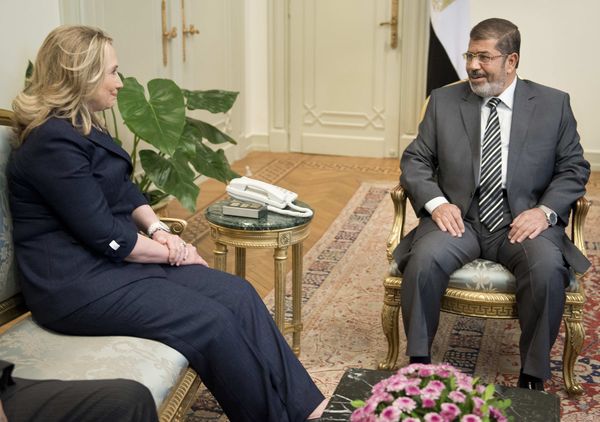
U.S. Secretary of State Hillary Rodham Clinton meets for the first time with new President Mohamed Morsi.
U.S. Secretary of State Hillary Clinton meets with Egyptian President Mohammed Morsi at the presidential palace in Cairo on July 14, 2012.
(Brendan Smialowski / Associated Press)
Oct. 8, 2012
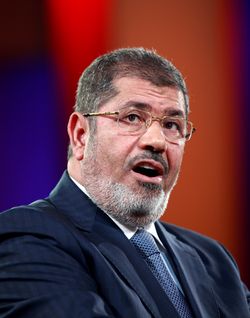
Egyptian President Mohamed Morsi issues a blanket pardon for hundreds of activists arrested during the revolution and its turbulent aftermath, in what was widely viewed as a morally wise but politically timed move from a leader attempting to calm his critics amid social and economic turmoil.
Egyptian President Mohamed Morsi, shown speaking last month at the Clinton Global Initiative in New York, has offered a blanket pardon of hundreds of activists arrested during last year’s revolution and its aftermath.
(David Karp / Associated Press)
Nov. 23, 2012
Clashes erupt across Egypt over President Mohamed Morsi's decree expanding his authority, a move that sharpens lines between Islamists and those who fear the president is stealing power in order to edge the country closer to Islamic law.
Protesters in Tahrir Square demonstrate against Egyptian President Mohamed Morsi's decree.
(Andre Pain / European Pressphoto Agency)
Nov. 30, 2012
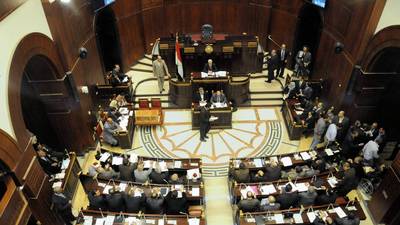
Egypt's Islamist-dominated constitutional assembly passes a rushed draft of a constitution to ease public anger against President Mohamed Morsi's expanded powers and preempt an expected court decision to disband the chamber the following weekend.
Egypt's Islamist-dominated constitutional assembly is gathered during its 16-hour session that culminated early Friday with the adoption of a draft constitution for the country.
(European Pressphoto Agency)
Dec. 8, 2012
Morsi rescinds his 2-week-old decree seizing broad powers and putting his office beyond judicial oversight. But the move fails to calm unrest as the president refuses to cancel a referendum later in the month on a proposed constitution drafted by an Islamist-dominated assembly.
An Egyptian protester argues with an army officer during a demonstration near the presidential palace in Cairo, Egypt.
(Khaled Elfiqi / EPA)
Dec. 22, 2012
Morsi scores a victory in his push for an Islamist state when a controversial new constitution is approved by 64% of voters in a two-round referendum. But the secular opposition accuses the president’s Islamist allies of fraud, portending more conflict between Muslim Brotherhood supporters and a newly collaborative opposition, the National Salvation Front, which includes Nobel laureate Mohamed ElBaradei and former Arab League Secretary-General Amr Moussa.
Jan. 27, 2013
Morsi invokes emergency powers in Ismailia, Port Said and Suez to quell riots that have killed nearly 50 and raised questions on whether his Islamist-backed government can secure order amid intensifying political turmoil.
March 3, 2013
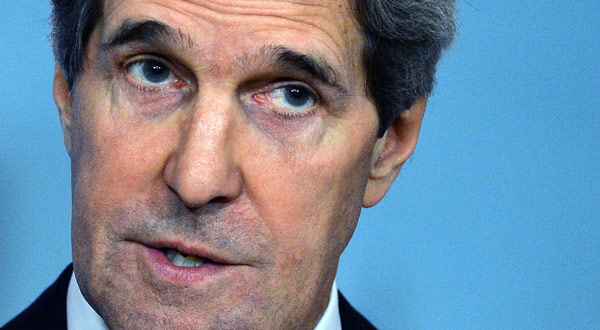
The U.S. government releases $250 million in aid to Morsi’s government in exchange for pledges of political and economic reforms. Secretary of State John F. Kerry serves notice that the Obama administration will keep close watch on how Morsi honors his commitments and that future aid will be dependent on fulfilling promises of building democracy. Egypt is also struggling to meet conditions for a $4.8-billion loan package from the International Monetary Fund.
US Secretary of State John Kerry answers a question duirng a joint press briefing with Jordanian Foreign Minister Nasser Judeh.
(Jewel Sawad/AFP/Getty Images)
March 30, 2013
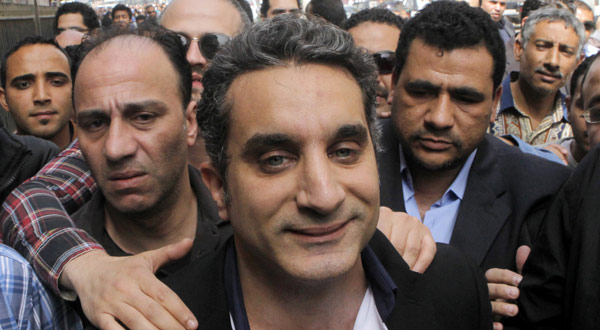
Egyptian state prosecutors order the arrest of popular television satirist Bassem Youssef for allegedly insulting Islam and Morsi. The order reflects an accelerated campaign to stifle protest and opposition to the Islamist president as it follows the arrest a week earlier of five prominent pro-democracy activists.
A bodyguard secures popular Egyptian television satirist Bassem Youssef, who has come to be known as Egypt's Jon Stewart, as he enters Egypt's state prosecutors office to face accusations.
(Amr Nabil/Associated Press)
April 29, 2013
An alcohol-free hotel in the Red Sea resort of Hurghada opens, testament to the spreading influence of Islamic values in Egyptian commerce and society. The opening, marked by the ceremonial dumping of liquor bottle contents on the resort’s sidewalks, is cheered by Islamists but denounced by secular political and business leaders as a threat to Egypt’s tourism industry, already devastated by two years of political turmoil.
May 7, 2013
Morsi reshuffles his Cabinet, strengthening the Muslim Brotherhood’s hold on power and angering opposition leaders who had demanded more secular ministers to balance Islamist influence in the government’s upper ranks.
June 4, 2013
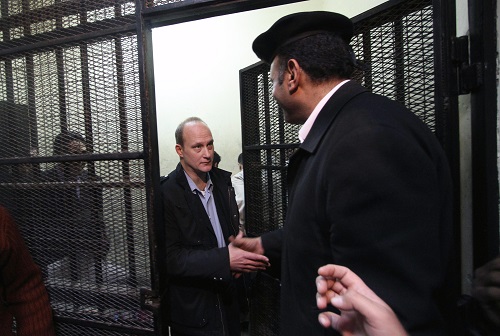
Nineteen Americans are convicted on charges of operating illegally funded organizations for their work helping Egyptians build civil society institutions. The U.S. defendants, all but one already out of the country, are sentenced to five-year prison terms. The move angers Washington and Egypt’s secular opposition, as it is seen as an effort to repress rival political forces challenging Morsi’s Muslim Brotherhood allies.
American Robert Becker, of the National Democratic Institute, leaves the defendants' cage after a court hearing March 8, 2012. He received a two-year jail term.
(Associated Press)
June 30, 2013
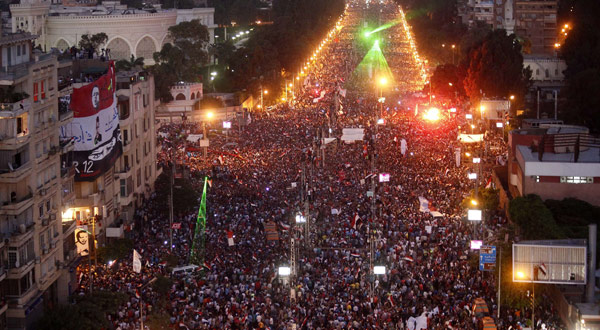
Hundreds of thousands fill town and city centers across Egypt to denounce Morsi on the first anniversary of his inauguration. The protests against his Islamist agenda and heavy-handed moves to shackle political opposition are countered by the turnout of Morsi supporters, leading to deadly clashes and violence that escalates into a massive force demanding the president step down.
Hundreds of thousands of Egyptian demonstrators gather outside the presidential palace in Cairo during a protest.
(Mahmud Khaled/AFP/Getty Images)
July 3, 2013
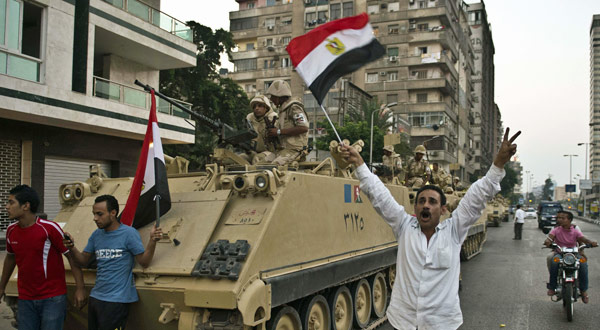
Egypt's military, which two days earlier had issued an ultimatum that Morsi end the disruptive turmoil paralyzing the country within 48 hours, announces that it has removed him from office and suspended the constitution. Demonstrators celebrate in Cairo's Tahrir Square, restoring the scene of revolutionary chaos that ensued after Mubarak's February 2011 ouster.
Egyptians salute Army tanks upon their deployment on a street leading to Cairo University.
(Khaled Desouki/AFP/Getty Images)