The fitful progress of 911 at LAFD
The recent controversy over the Los Angeles Fire Department’s 911 response is rooted in unresolved call-handling problems that have spanned a quarter century and been tied to a series of controversial deaths.
The death of Ziporah Lam
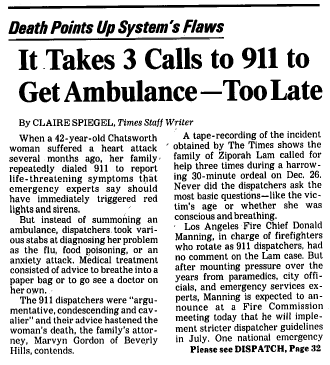
Though city reports dating back to the 1970s said LAFD needed to improve, it was the death of Ziporah Lam, which made national news, that forced the department to change.
Dispatchers twice refused to send an ambulance to help the 42-year-old woman, with one dispatcher telling her husband, “We don’t come out for people that aren’t feeling well.”
Finally, more than 20 minutes later, a dispatcher alerted an ambulance when Lam’s son called a third time and said she was foaming at the mouth and choking. She died after suffering a cardiac arrest.
LAFD calls in Clawson
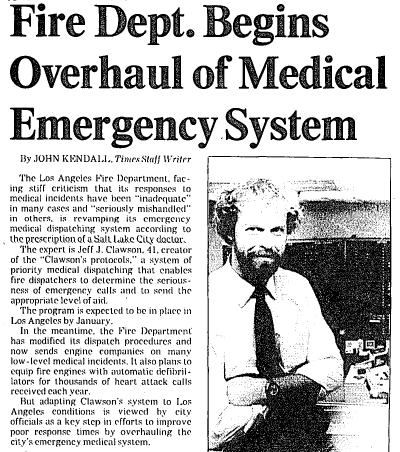
Vowing to change the operation, the city hired Dr. Jeff Clawson to develop a scripted system of questions and responses for LAFD dispatchers.
The system, which Clawson first developed a decade earlier in Salt Lake City, used color-coded questions on flip cards mounted by each dispatcher’s phone.
The questions started with basics: location, primary complaint and whether patients were breathing and conscious. A caller’s responses helped dispatchers decide whether to alert firefighters or more highly trained paramedics.
Rescuers complain about sending help to ‘hangnails’
LAFD staff speak out to The Times and argue that Clawson’s system fails to avoid sending staff out on nuisance calls.
“I’d guess a good 30% of the calls we go out on don’t really need us,” said paramedic Cindy Sweem.
Clawson said that he set up guidelines for fixing the problem, but that fire officials dropped the ball.
LAFD report deems paramedic strategy a ‘tragedy’
An internal LAFD report said the agency’s brass needed to abandon a flawed deployment strategy that “cheated people out of full medical service and jeopardized lives.”
Despite the fact that 80% of calls for help were medical, the department’s deployment strategy emphasized firefighting readiness over emergency medical care. The report concluded the mismatch may have affected more than 4,000 patients who died during that time.
Dispatchers faulted for not sticking to the script
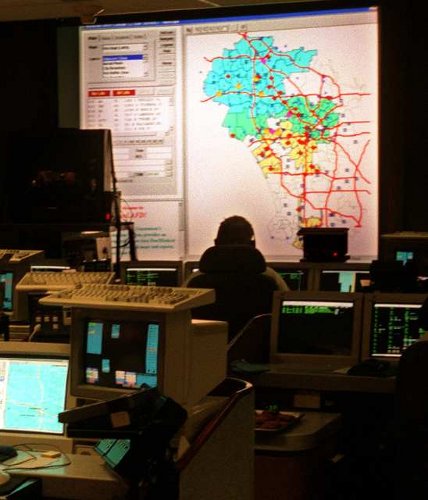
The Times reported that at least three patients died in heart attack and cardiac arrest incidents after dispatchers had failed to follow the scripted questions. At the time, an LAFD study found, dispatchers were failing to ask key questions in nearly half the 911 calls they handled.
Top fire officials vowed to overhaul the operation and buy interactive computer software that would record whether dispatchers asked questions and require them to enter the answers before they could send rescuers to help.
The goal, fire officials said, was to obtain national accreditation for the dispatch center, which would prove the agency was adhering to the highest standards.
The accreditation is awarded by the National Academies of Emergency Dispatch, founded by Clawson to set dispatching standards and provide training to fire and police agencies.
As of September 2012, LAFD had yet to be accredited.
Dispatch times lag behind national standards
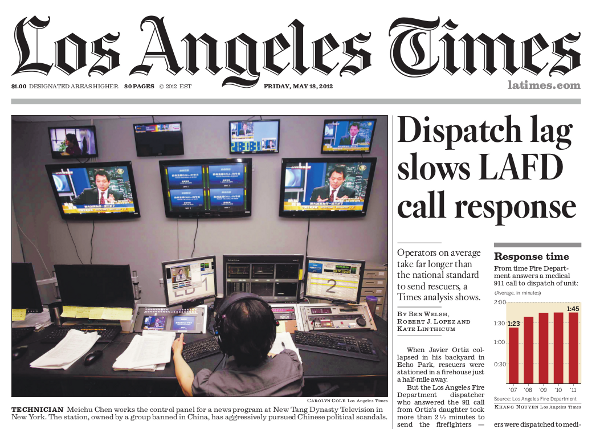
After LAFD officials admitted to publishing statistics that overstated the department’s response times, The Times conducted an independent analysis and found that dispatchers lag far behind national standards.
A Times analysis of the department’s database found that in the more than 250,000 medical dispatches in 2011, dispatchers took 1 minute and 45 seconds on average, 75% longer than the national standard.
Audit confirms Times analysis
The city controller released an audit of LAFD response times, confirming The Times’ conclusion that LAFD dispatchers lag well behind national standards.
The audit also faulted fire officials for undercutting public confidence in the department by producing misleading statistics. “It’s unacceptable that the LAFD has not been able to accurately track its emergency response times,” it said.
Dispatchers waste time getting 911 callers to start CPR
An internal LAFD study obtained by The Times concluded LAFD dispatchers waste valuable time getting 911 callers to start CPR on cardiac arrest victims, often beginning the life-saving procedure after the point at which brain death begins.
The study said chest compressions were started in just 31% of the 166 cardiac arrest calls reviewed. In cases in which chest compressions were started, dispatchers took on average more than 4 minutes to get the process started.
LAFD’s medical director, Dr. Marc Eckstein, said the department wanted to revise some questions in Clawson’s script and would be enacting a policy to require dispatchers to send the closest fire engine and paramedic ambulance without delay on critical emergencies such as cardiac arrests.
Clawson defended his scripted system and disputed the findings of the report.
“It never has a bad hair day,” he said of the dispatching software. “People who follow it by the numbers don’t have these types of problems.”
Rewrite ordered for call-handling scripts
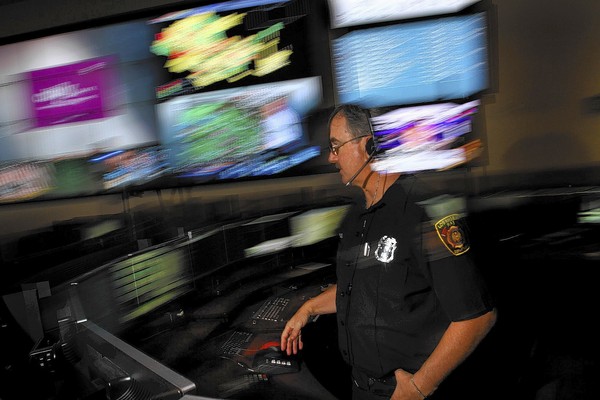
LAFD officials say they will launch a sweeping overhaul of cumbersome 911 call handling procedures that officials say contribute to delays in getting rescuers to victims in life-threatening medical emergencies.
Some dispatchers complain the scripted questions, instituted more than two decades ago after dispatchers mistakenly diagnosed Ziporah Lam, are wasting precious time.
“We ask a lot of questions that end up going nowhere, providing us with nothing and really upsetting people and delaying a response,” said veteran LAFD dispatcher Robert Ashley.
The new program being created by department staff will have fewer questions and allow more flexibility to get rescue units moving as details are being gathered from 911 callers, officials said.
Sources: Times research
Credits: Robert J. Lopez, Kate Linthicum, Ben Welsh