July 13, 2011
"A shift in revolutionary tactics"
#OWS
In a blog post , Adbusters, a Vancouver-based anti-consumerist magazine, cites the revolution strategies in Egypt and Spain and proposes a similar protest against Wall Street.
“On September 17, we want to see 20,000 people flood into lower Manhattan, set up tents, kitchens, peaceful barricades and occupy Wall Street for a few months.” --Adbusters
Sept. 17, 2011
Manhattan
#OWS
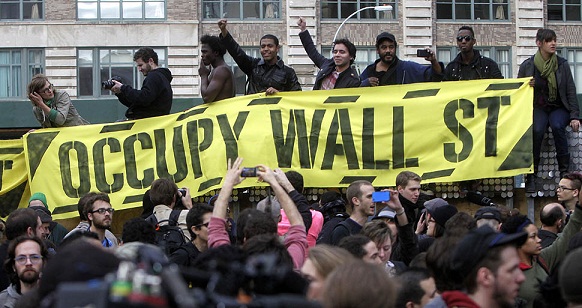
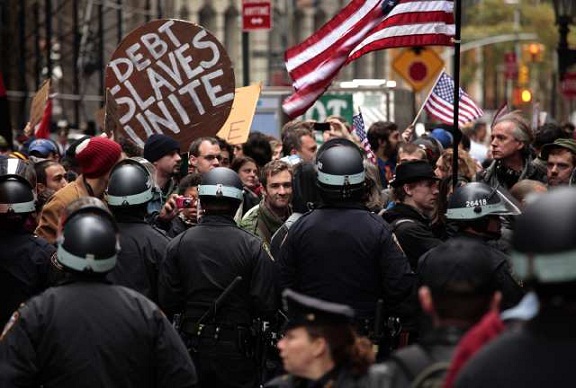
The idea catches on two months later when hundreds of people march along Broadway, demanding an end to Wall Street and corporate greed. About 150 people set up camp in Zuccotti Park, a privately owned space near Wall Street.
Describing itself as a "leaderless resistance movement," the group stages a number of rallies and marches in the next two weeks but has yet to determine specific demands.
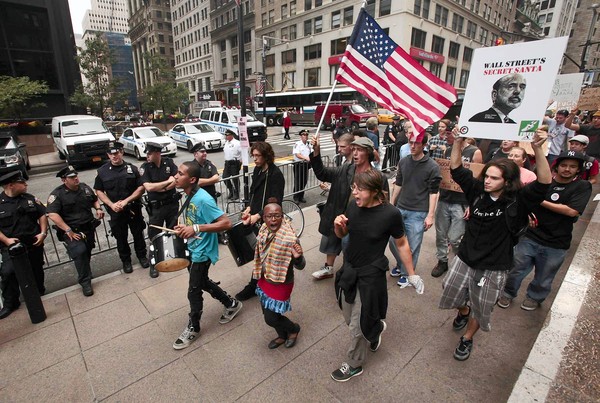
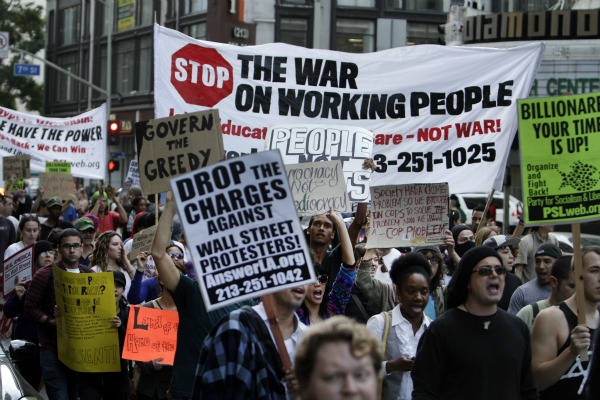
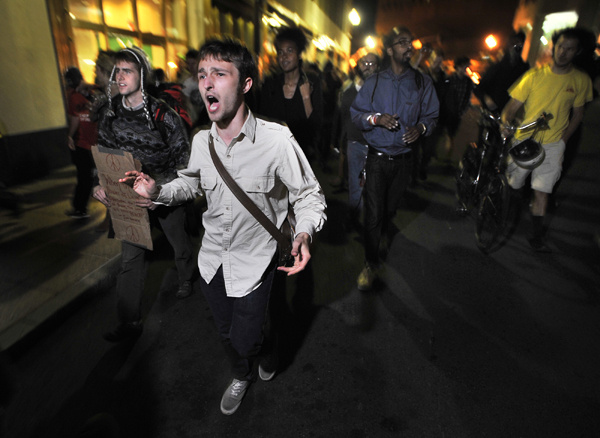
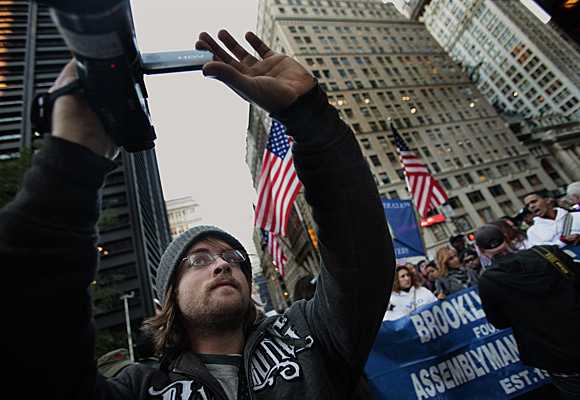
A march through the streets of Lower Manhattan on Sept. 30, 2011.
(Carolyn Cole / Los Angeles Times)
Sept. 29, 2011
At a crossroads
#OWS
Two weeks into the demonstration, some supporters wonder how far Occupy Wall Street can go if it does not translate its anger into more specific demands.
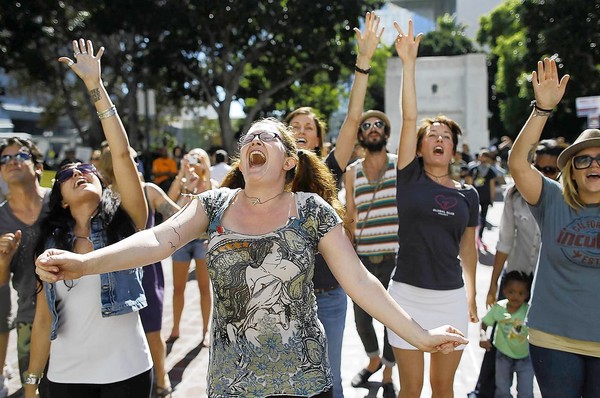
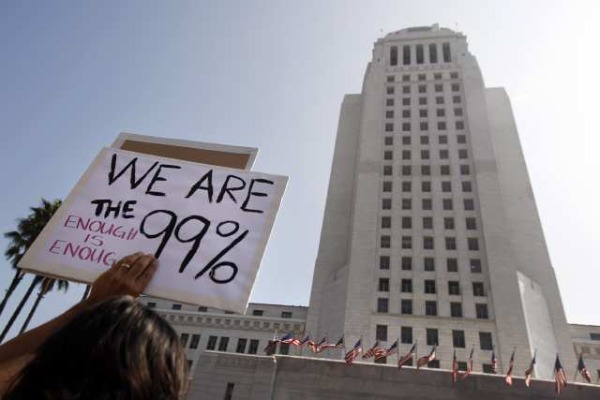
Emerging from many chants and slogans, "the 99 percent" has become the leading phrase used by demonstrators, contrasting themselves with the 1% of Americans at the top of the income scale.
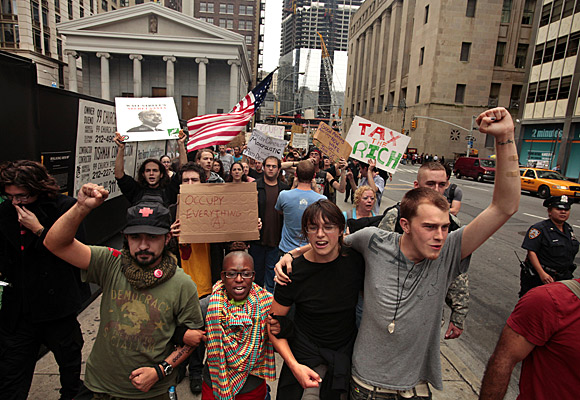
Day 13: Occupy Wall Street begins the morning with a march around the time the opening bell rings at the stock exchange.
(Carolyn Cole / Los Angeles Times)
Sept. 30, 2011
Publicizing the movement
#OWS
The protest is gaining traction but still has no long-term strategy. Thousands gather in Zuccotti Park on a Friday evening after an announcement on Occupy Wall Street’s website said that the band Radiohead would put on a free show. Hours later, a correction and apology were posted.
Many come to the park for the band and have no interest in the protest, which onlookers say still appears disorganized.
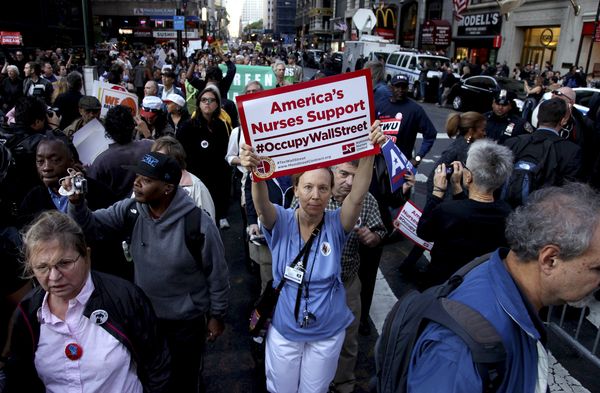
Occupy Wall Street protesters rally in New York.
(Seth Wenig / Associated Press)
Oct. 1, 2011
Manhattan: 700 arrested
#OWS
More than 700 demonstrators are arrested in a march on the Brooklyn Bridge, sparking national attention.
Many protestors say they were led into the bridge’s traffic lanes and then trapped by officers. Police release videos showing officers warning demonstrators to leave the vehicle lanes or face arrest.
Most of those detained are released the following day .
Oct. 1, 2011
Occupy Los Angeles
#OccupyLA
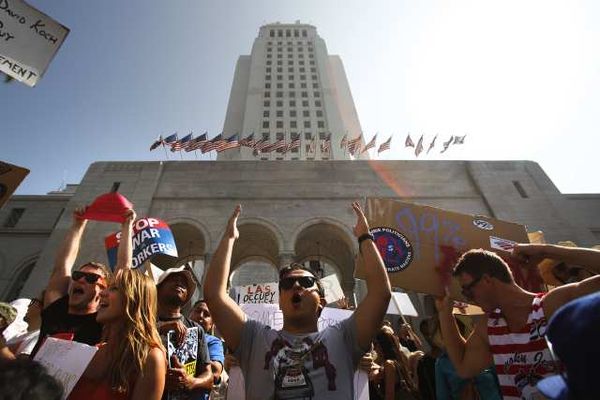
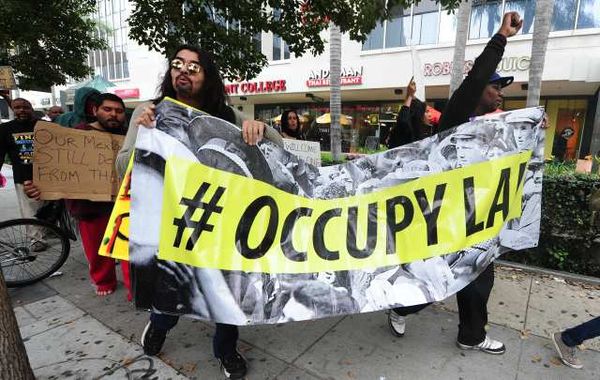
Occupy Wall Street inspires the West coast -- several hundred people meet in Pershing Square and march to Los Angeles City Hall, protesting U.S. economic policies and inequities.
About 15 volunteers help coordinate the protest by getting permits and working with the Los Angeles Police Department, but no one claims the role of group leader. More than 100 marchers remain overnight outside City Hall.
Protestors march to L.A. City Hall in solidarity with the Occupy Wall Street movement.
(Kevork Djansezian / Getty Images)
Oct. 1, 2011
Occupy DC
The world
The U.S. capital also takes on the Occupy Wall Street theme, beginning a demonstration in Washington’s McPherson Square. During its first week, Occupy DC draws about 10 to 50 people a day, with protesters attending a 6 p.m. meeting and waving signs at people as they leave their K Street offices.
Protesters in cities such as Boston and Chicago also begin camp-ins.
Oct. 2, 2011
Getting the word out
#OWS
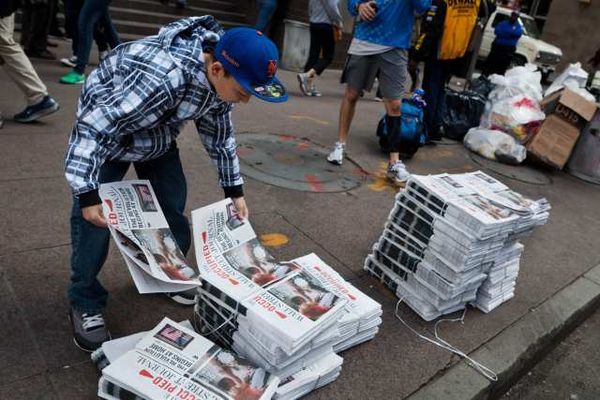
The media are ignoring the demonstrations, protestors say as they hand out copies of the Occupied Wall Street Journal. Sunday’s lead headline: "The Revolution Begins at Home."
Volunteers also work in a "media center" in Zuccotti Park, posting group activity updates on laptops powered by generators.
Protests have drawn an assortment of activists -- including college students anarchists anarchists and ordinary Americans focused on what they see as the banking industry's role in the growing divide between America's rich and poor.
Passersby pick up the Occupied Wall Street Journal.
(John Minchillo / Associated Press)
Oct. 2, 2011
Occupy L.A. is “here to stay”
#OccupyLA
Los Angeles protesters say they plan to camp outside City Hall indefinitely or until they draw enough attention to their cause.
Most participants say they had heard about the Occupy L.A. protest via Twitter and on social media sites such as Tumblr and Reddit.
Los Angeles police have not arrested any protesters and say that the as long as the protesters remain peaceful, police have no plans to oust them.
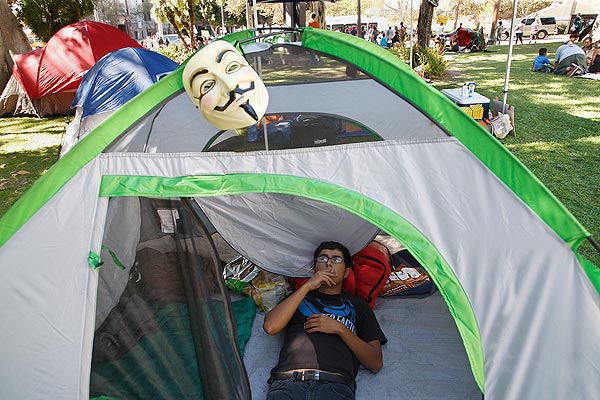
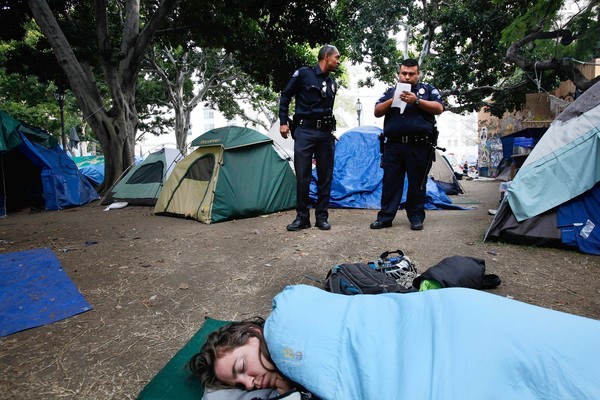
Tony Rodriguez, 25, of East Los Angeles set up camp outside Los Angeles City Hall.
(Gary Friedman / Los Angeles Times )
Oct. 2, 2011
Lawful assembly
#OccupyLA
The second day of the Occupy L.A. protest goes by without incident or arrests. An estimated 150 to 200 people participate in the sleep-in.
"They're out there exercising their 1st Amendment right, so we're going to allow them to continue as long it doesn't become an unlawful assembly," an LAPD official says.
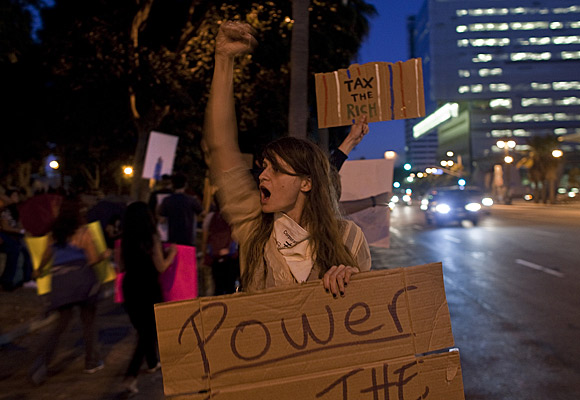
Shayne Eastin, 27, of Los Angeles protests on the second day of Occupy L.A.
(Gina Ferazzi / Los Angeles Times)
Oct. 3, 2011
A warm welcome
#OccupyLA
The Los Angeles City Council passes a resolution in support of the demonstration, providing portable toilets and choosing not to enforce a ban on sleeping overnight in city parks.
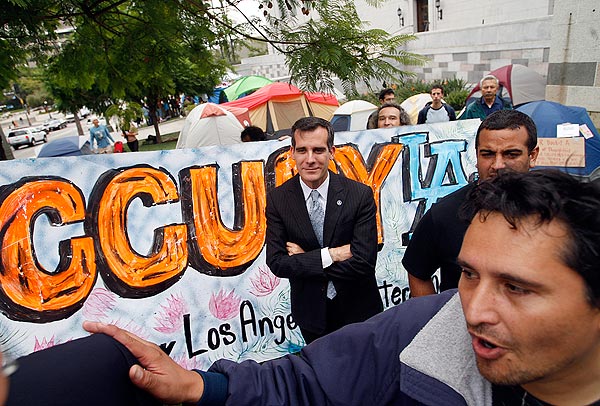
Council President Eric Garcetti invites protesters to "stay as long as you need to," and on a wet morning, Mayor Antonio Villaraigosa’s aides hand out rain slickers.
Los Angeles City Council President Eric Garcetti visits the Occupy L.A. campsite. (Oct. 4, 2011)
(Gary Friedman / Los Angeles Times)
Oct. 4, 2011
Becoming a national movement
The world
The protests against banks and politicians have spread nationwide, from Boston, to Chicago, to Kona, Hawaii. The anti-corporate push even gets a nod from Federal Reserve Chairman Ben S. Bernanke , who says: "On some level, I can't blame them."
Labor union support across the country has also helped the movement gain momentum.
A group protests outside the Balboa Bay Club in Newport Beach.
(Christine House / For The Times)
Oct. 5, 2011
Union support
Followers
Occupy Wall Street gains the backing of more than a dozen prominent unions and more than 20 community groups representing those who have been hit hard by the economic downturn.
Richard Trumka, president of the AFL-CIO, announces the labor federation’s support . But the labor leader is specific as he summarizes his demands: Make Wall Street invest in creating jobs for Americans, stop foreclosures, and write down problem mortgages.
Groups such as ReFund California and MoveOn.org also announce support for the protests in Southern California.
Occupy L.A. protesters march along Broadway in downtown Los Angeles.
(Lawrence K. Ho / Los Angeles Times)
Oct. 5, 2011
Massive march
#OWS
In the biggest march in New York since the movement began Sept. 17, thousands of people take to the streets after major labor unions give their backing to Occupy Wall Street's anti-greed message -- a sign that the movement is shifting from a loose-knit fringe group to a bloc that could draw in mainstream America.
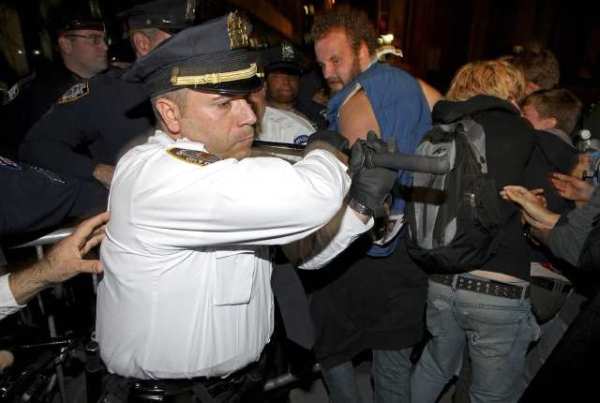
Police say they made 28 arrests after the march , when some protestors tried to actually occupy Wall Street and stormed barricades keeping people out of the vehicle lanes.
A police officer swings his baton to keep marchers behind barricades in Manhattan.
(Craig Ruttle / Associated Press)
Oct. 5, 2011
50-plus cities
The world
The Occupy Wall Street movement has spread to about 50 cities across the country, including Portland, Ore., and Seattle.
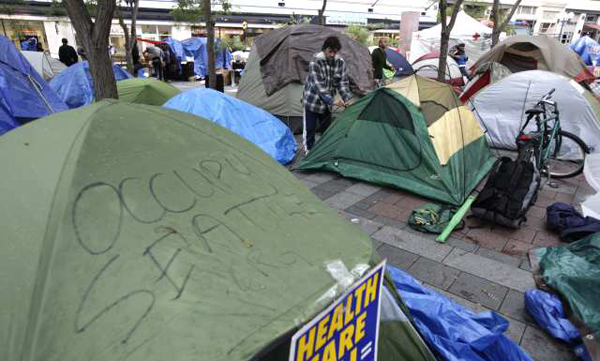
In Seattle, police arrest 10 people who tried to prevent the dismantling of tents in a downtown plaza where about 100 protesters had set up camp in the rain.
The Occupy Seattle encampment in downtown Seattle's Westlake Park.
(Ted S. Warren / Associated Press)
Oct. 5, 2011
Presidential candidates weigh in
Political response
The White House has yet to comment on the Occupy Wall Street movement, but at least two Republican presidential hopefuls express their thoughts.
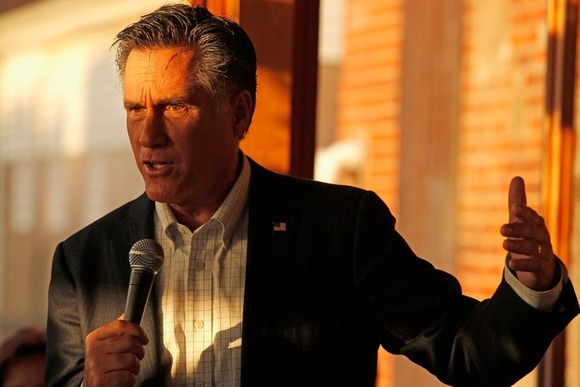
Mitt Romney calls the protest "class warfare." "I'm just trying to occupy the White House," he says in Florida.
In response to questions from a San Francisco audience, Michele Bachmann says the difference between the tea party and the Occupy Wall Street protesters is that the tea party "picks up its trash."
Mitt Romney in Muscatine, Iowa. (Dec. 28, 2011)
(Chip Somodevilla / Getty Images)
Oct. 6, 2011
Occupy DC
The world
More than 500 chanting people kick off Washington’s biggest version to date of the Occupy Wall Street protests.
The day is officially an anti-corporate “Stop the Machine” rally that had been months in the making. But with Occupy Wall Street gathering attention around the nation, Occupy DC merges into this much larger protest.
The protesters include a wide range of ages, from toddlers to seniors in wheelchairs.
A rally outside the Chamber of Commerce in Washington, D.C.
(Jacquelyn Martin / Associated Press)
Oct. 6, 2011
Los Angeles
Followers
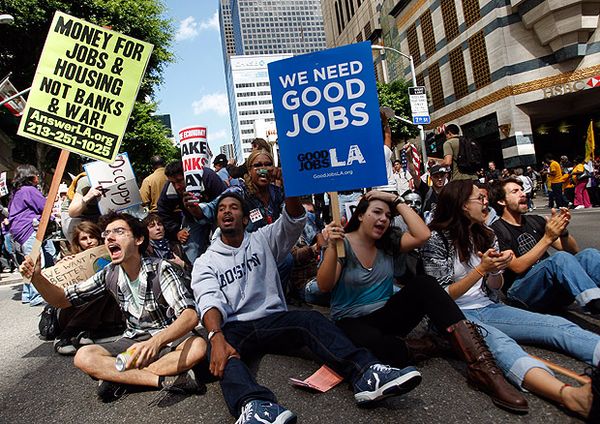
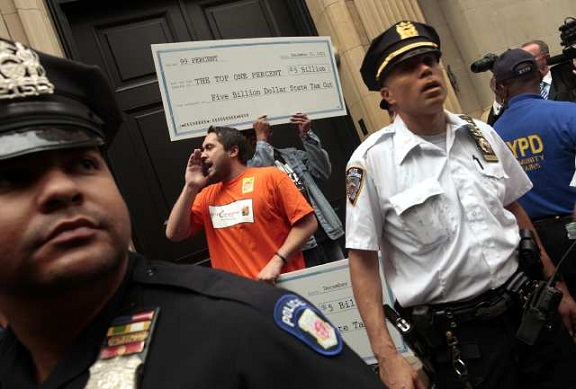
Los Angeles police arrest 10 people at a downtown Bank of America branch after they try to cash a check for $673 billion made out to the "people of California." The demonstrators sat down and refused to leave the bank, police said.
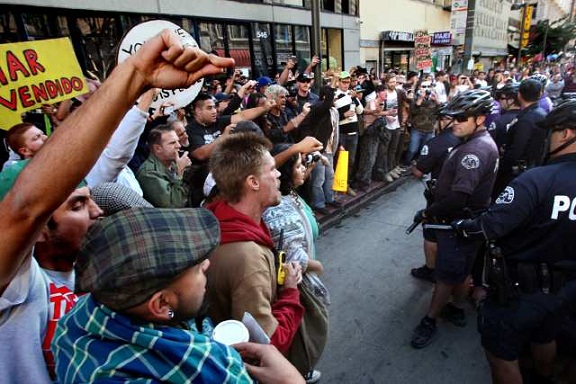
About 500 protesters also take over the intersection of 7th and Figueroa streets, prompting police in riot gear to respond.
The march was sponsored by the ReFund California campaign with support from Occupy Los Angeles protesters.
Protesters take over the intersection of 7th and Figueroa streets.
(Genaro Molina / Los Angeles Times)
Oct. 6, 2011
A tea party for Democrats?
Political response
More politicians begin to weigh in on the Occupy protests that began three weeks ago. They have "a lot in common with the tea party," Vice President Joe Biden says at a forum sponsored by the Atlantic magazine.
However, liberals say that the origins are more spontaneous and authentic than the tea party movement. Tea party followers are also sharply focused on one issue -- cutting government spending -- while Occupy Wall Street is still amorphous in its aims.
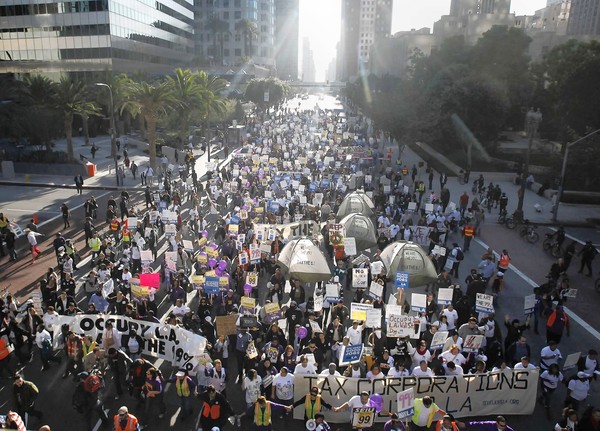
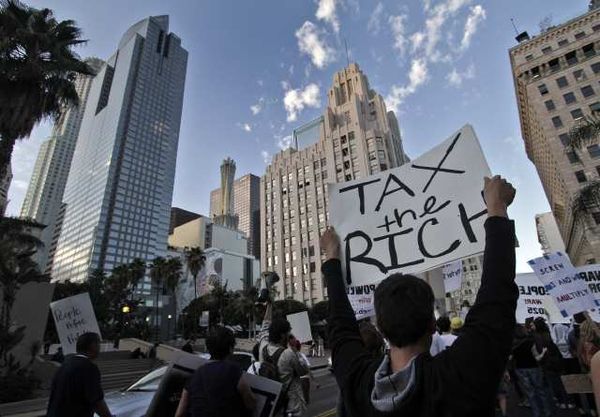
Demonstrators crowd onto a downtown Los Angeles street.
(Mark Boster / Los Angeles Times)
Oct. 6, 2011
Occupy in China
The world
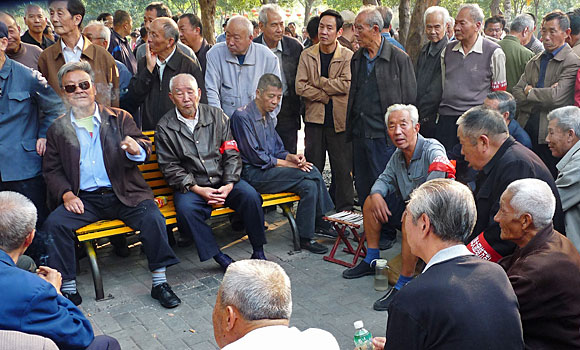
Hundreds of pensioners and Communist Party members gather to express their solidarity with the movement in Zhengzhou, a city in Henan province.
Within days, videos and pictures of the demonstrations are scrubbed from the Internet. Censors have selectively blocked discussion of Occupy Wall Street on social media websites.
The Zhengzhou demonstration, as well as a similar demonstration in Luoyang, another city in Henan province, are China’s only documented gatherings in support of Occupy Wall Street, The Times reported.
Elderly Chinese at a park in Zhengzhou gather to show support for Occupy Wall Street protesters. (Oct. 8, 2011)
(AFP/Getty Images)
Oct. 7, 2011
San Diego
The world
More than 1,000 protestors, according to organizers, march in solidarity with the nationwide protests aimed at a variety of economic and social issues, including high unemployment, greed and corruption.
Several hundred Occupy San Diego protestors remain camped out the following day behind City Hall. One sign reads: "If San Diego Is Protesting, Something Big Is Happening."
Occupy L.A. protesters march downtown. (Oct. 3, 2011)
(Lawrence K. Ho / Los Angeles Times)
Oct. 9, 2011
Followers
Gen. Masoud Jazayeri of Iran's Revolutionary Guard, who is often involved in anti-U.S. propaganda efforts, labels the spreading Occupy protests as an "American Spring."
"The failure of the U.S. president to resolve the Wall Street crisis will turn this economic movement into a political and social movement protesting the very structure of the U.S. government," the official Islamic Republic News Agency quotes Jazayeri as saying.
Oct. 10, 2011
Nation undecided
Media response
A Reuters/Ipsos poll of 1,113 adults, conducted Oct. 6 to 10, finds that 82% of Americans have heard of the protest movement. And although 38% view it favorably, 35% are undecided. A minority, 24%, views the protests unfavorably.
Another poll, by the Pew Research Center , finds that about a quarter of Americans (27%) cite the U.S. economy as their top news interest; only 7% cite the Occupy Wall Street protests.
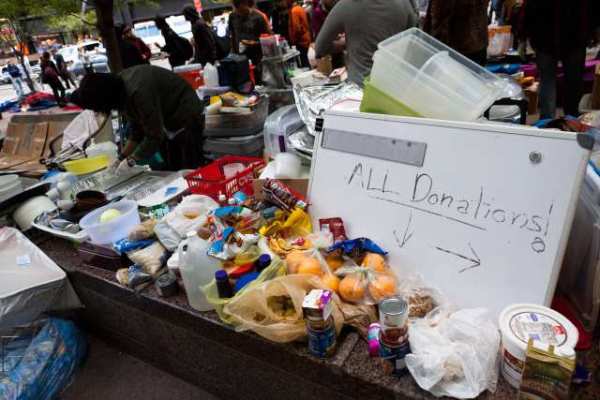
Supported by food donations, the Occupy Wall Street camp vows to push on with its protest.
(John Minchillo / Associated Press)
Oct. 10, 2011
Boston
The world
About 100 people are arrested on a Monday evening in Boston, according to local news affiliates, after they refuse to leave an off-limits area outside of the Dewey Square section of the city.
Demonstrators with Occupy Boston march toward the police station, where fellow demonstrators were taken after arrests. (Oct. 11, 2011)
(Josh Reynolds / Associated Press )
Oct. 10, 2011
Romney speaks again
Political response
Occupy Wall Street enters its fourth week of protest, vowing to push on. Mitt Romney takes a more sympathetic tone in remarks about the movement, which he had called “dangerous” just a week before.
“I look at what’s happening on Wall Street and my view is, boy, I understand how those people feel,” he says at a town hall event in Hopkinton, N.H.
Oct. 10, 2011
An awakening
#OccupyLA
Los Angeles Times columnist Steve Lopez spends a night with Occupy L.A., trying to make more sense of the demonstrators who've taken to the streets in cities across the country.
He meets some of the self-identified leaders of the L.A. encampment. Kwazi Nkrumah, 57, a longtime activist, says that going forward, the demonstrators will need to plan more specific "actions."
He and Mario Brito, an unemployed union organizer, helped organize Occupy L.A.
"I said the first night if we had 500 people march and 50 camp out, I'd be happy," Brito says. "It was about 5,000 marchers and 100 camping out."
Lauren Rock of Los Angeles dances with dozens of other demonstrators as a band called the Mowglis performs on the steps of City Hall.
(Robert Gauthier / Los Angeles Times)
Oct. 11, 2011
Tea party group responds
Media response
Conservatives continue to dispute a building media narrative that has likened Occupy Wall Street to the rise of the tea party. The group Tea Party Patriots releases a statement contrasting the two.
Tea party adherents, say the group’s co-founders, “don’t believe corporations are inherently evil, nor should bankers be beheaded.... In fact, they want more of what made America great: more Constitutional restraint on government so that the people have more freedom to achieve the good things the country offers.”
They also contend that tea party rallies have been “safe and clean,” unlike civil unrest caused by “lawbreaking troublemakers.”
Oct. 11, 2011
Politicking
Political response
The Occupy Wall Street movement has become a catch phrase in national presidential politics.
Democrats, led by President Obama, have said they feel the frustration and pain of the protestors, while Republicans have said the demonstrations are another example of how Democrats continue to exploit fissures in society as part of an electoral campaign strategy to heighten “class war.”
The Occupy movement’s central argument is that corporate greed has damaged the nation’s economy while rewarding the rich, thus making income inequality in the country sharper.
The "Millionaires March" in New York stopped at the home of hedge fund billionaire John Paulson in Manhattan. (Oct. 11, 2011)
(Carolyn Cole / Los Angeles Times)
Oct. 12, 2011
Media catches on
Media response
Los Angeles Times media columnist James Rainey challenges his colleagues to look at the Occupy protests with fresh eyes. The media have a history of getting mass social movements wrong, he writes.
Reporters want to know what these large and often-amorphous gatherings mean. Editors and producers want an instant take. And protest organizers crave the attention. They insist on their story being told, even as they're arguing about just what the story should be.
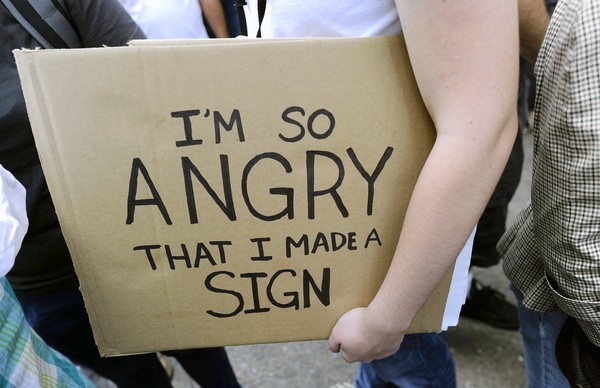
One Occupy Wall Street protester holds a sign: "The press won't interview me because I look too normal."
An Occupy Wall Street protester's message in New York. (Oct. 10, 2011)
(Timothy A. Clary / AFP/Getty Images)
Oct. 12, 2011
Explaining the 99%
Media response
The concerns of the protesters are considerably more focused than their critics acknowledge, writes Los Angeles Times columnist Michael Hiltzik.
It's about the soaring income gap. In three decades, the average income of the top 1% has grown -- to 100 times, from 30 times, that of the lowest 20% of households.
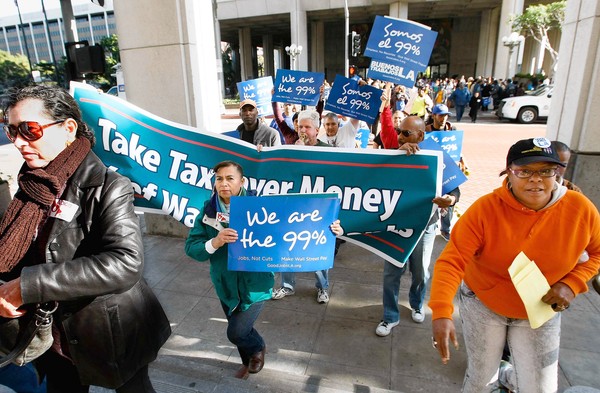
These are the numbers that inspire the Wall Street protests, with slogans such as "We are the 99%" and "The banks got bailed out, we got sold out."
A few thousand people take part in a march that started at Pershing Square and ended at Los Angeles City Hall. (Oct. 15, 2011)
(Rick Loomis / Los Angeles Times)
Oct. 12, 2011
In San Fancisco
The world
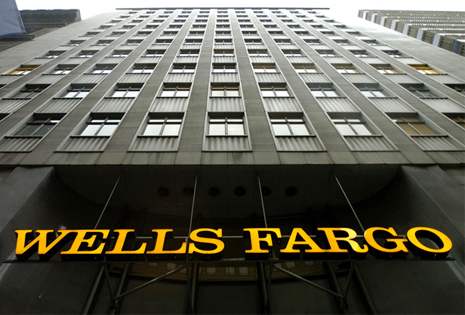
San Francisco police arrest at least 11 Occupy San Francisco protesters blocking the entrance to Wells Fargo's corporate headquarters.
About 200 activists gather and sit down in front of the entrance, pledging to "foreclose the banks," the San Francisco Chronicle reports .
Wells Fargo headquarters in San Francisco.
(Noah Berger / Bloomberg News)
Oct. 12, 2011
Bill Clinton's take
Followers
Former President Bill Clinton discusses the movement on "The Late Show."
He says the protests are “a positive thing” but worries about the nebulousness of the cause: "You need to be for something, not just against something."
Oct. 13, 2011
Celebrities visit the occupation
Followers
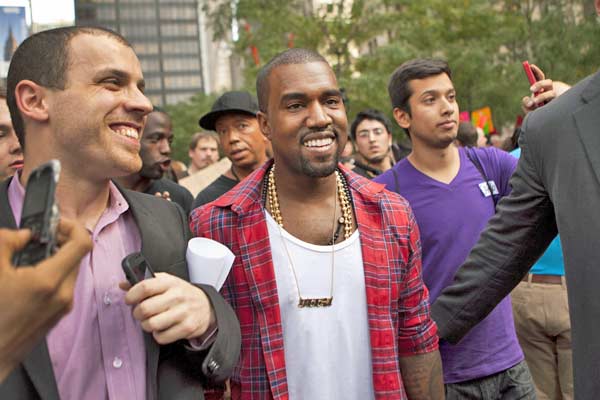
Musician Kanye West, activist and MSNBC host Al Sharpton, and hip-hop mogul Russell Simmons visit Zuccotti Park, but some protestors accuse them of using Occupy Wall Street to bolster their own profiles while perpetuating things the movement eschews, such as party politics, consumerism and sexism.
"We don't want to be used and co-opted,” one protestor says. “This is not a game."
Musician Kanye West visits the Occupy Wall Street protest in Zuccotti Park. (Oct. 10, 2011)
(Andrew Burton / Associated Press)
Oct. 14, 2011
Arrests
#OWS
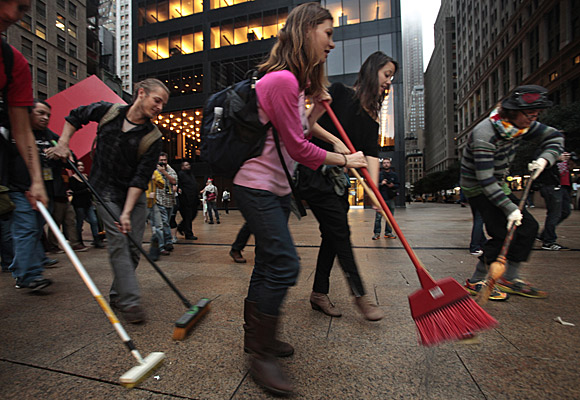
About 10 Occupy Wall Street protesters are arrested after they embark on an impromptu victory march through Lower Manhattan following the cancellation of a plan to clean the privately owned park where they have been camped for 28 days.
Protesters see the planned cleanup as a ploy to evict them from Zuccotti Park, even though park owner Brookfield Office Properties says it wants to move people only temporarily so it can scrub the plaza.
Protesters sweep the sidewalk in the financial district as part of a symbolic effort to clean up Wall Street.
(Carolyn Cole / Los Angeles Times)
Oct. 14, 2011
Evictions
The world
While authorities around the world brace for demonstrations planned for the weekend, police arrest almost two dozen people and remove tents from the Occupy Denver protest, and protesters in Trenton, N.J., are ordered to remove tents from their encampment, local media report.
Oct. 14, 2011
San Diego
The world
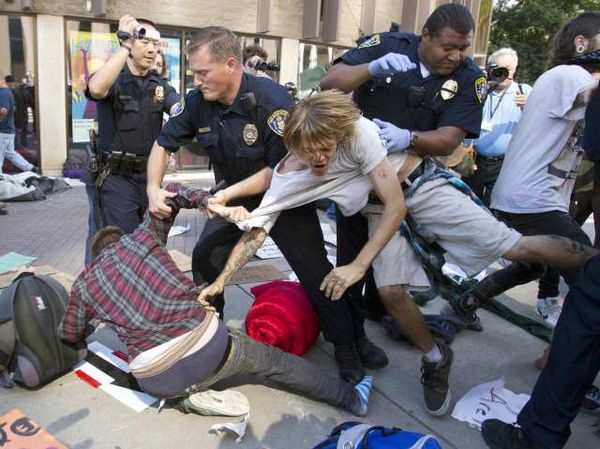
Two men, ages 21 and 39, are arrested on suspicion of attempting to block police from removing tents and property from the plaza behind San Diego City Hall after a 7 a.m. deadline .
Police say the protesters can remain but that their property has to be removed because of a municipal code that prohibits blocking public access. Several dozen protesters have voluntarily relocated to Balboa Park.
The following day, several hundred protesters take part in a downtown march . But by Oct. 17, only a few dozen will remain in the plaza.
Police tussle with Occupy San Diego protesters.
(Gregory Bull / Associated Press)
Oct. 15, 2011
Going global
The world
The protests take off abroad, spreading to the Asia-Pacific region, with marches staged in Australia, New Zealand, Japan and South Korea.
About 600 people join rallies in Tokyo, and more than 500 activists march in New Zealand.
The weekend demonstrations are organized as part of what activists described as a global movement involving about 85 countries.
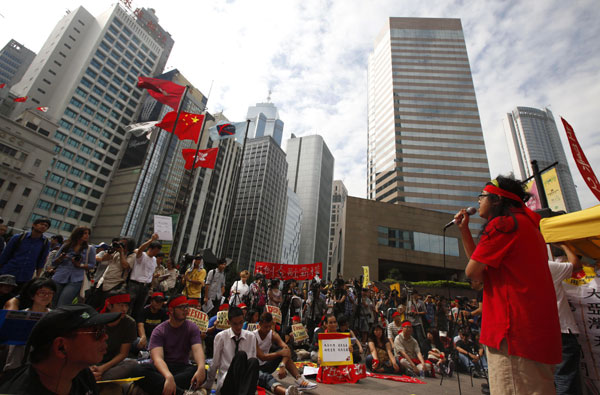
Occupy Hong Kong protesters rally outside Hong Kong Exchange Square.
(Kin Cheung / Associated Press)
Oct. 15, 2011
London
The world
Thousands of protesters gather on the steps of St. Paul’s Cathedral and march toward the London Stock Exchange building, vowing support for their counterparts in the Occupy Wall Street movement.
Julian Assange, founder of Wikileaks, tells the crowd on the steps of St. Paul’s that he blames greed, corruption and money-laundering in London for undermining the rule of law.
Protestors camp outside the church for more than two weeks before facing eviction.
Oct. 15, 2011
'Global day of action'
#OccupyLA
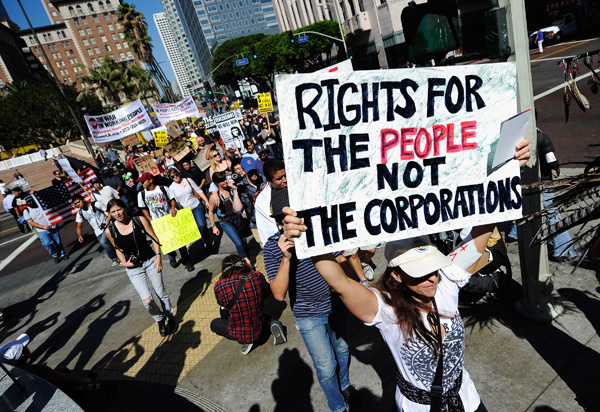
As protesters around the world mark a "global day of action," hundreds take to the streets of downtown Los Angeles to vent frustration over dismal job prospects and the failure of government to get the economy back on track.
Progressive group MoveOn.org organizes a second anti-greed protest.
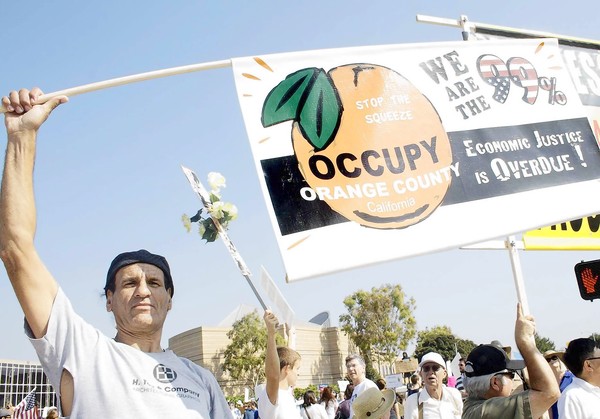
Meanwhile, more than 500 people join the Occupy O.C. protests.
Alex Sircello of Orange County with other protesters outside Irvine City Hall. (Oct. 15, 2011)
(Ani Yessayan / Times Community News)
Oct. 15, 2011
Long Beach
The world
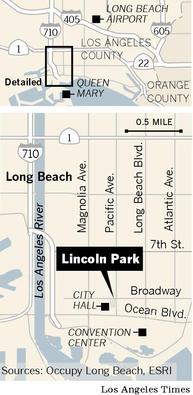
Occupy Long Beach begins in Lincoln Park. Unlike other demonstrators across the country, the three dozen or so Long Beach loyalists leave the grounds every night by 10 pm. to avoid violating a city ordinance that prohibits camping. So they return every morning for more than a month.
The few times they defiantly hold their ground result in fines and 15 arrests .
The location of the Occupy Long Beach protest.
(Los Angeles Times)
Oct. 16, 2011
The world
Police arrest 19 people, including Princeton University professor Cornel West, on the steps of the U.S. Supreme Court in Washington as part of the Occupy Wall Street movement.
Later reports say these protestors will not be prosecuted.
Global protests over the weekend lead to the arrests of more than 250 people in the United States and worldwide.
Oct. 17, 2011
Arrests across the U.S.
The world
Weekend demonstrations lead to several hundred arrests, including 70 in New York, 20 in Sacramento, 100 in Arizona (53 in Tucson and 46 in Phoenix), and about two dozen in Denver, the Associated Press reports.
In Chicago, a protest involving about 2,000 people leads to 500 people camping in Grant Park. Police make 175 arrests when they refuse to leave.
Oct. 17, 2011
#OccupyLA
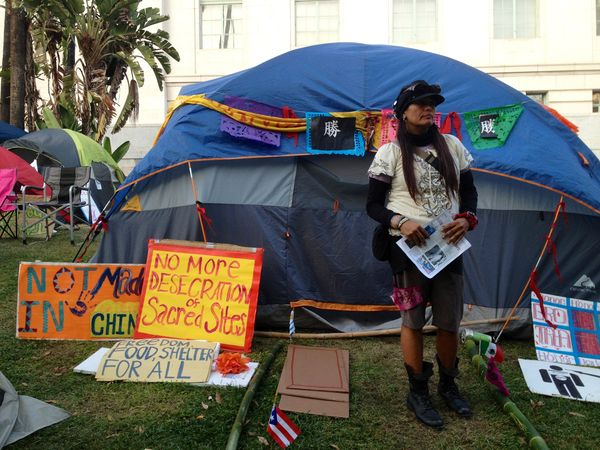
In the third week of its demonstration outside City Hall, Occupy L.A. continues to draw attention from media and outside supporters. Immigrant groups and the Indigenous Peoples' Committee join Occupy L.A., and plans are made to join forces with the Los Angeles teachers union to protest layoffs and other education cuts.
Students are brought to the camp to learn about democracy, and the movement inspires a new “I’m getting arrested” Android app.
Regina Quetzal Quiñones outside one of the Indigenous Peoples’ Committee tents in downtown Los Angeles.
(Ricardo Lopez / Los Angeles Times)
Oct. 17, 2011
Polling
Media response
Two-thirds of New York City voters agree with the views of Occupy Wall Street demonstrators, according to a Quinnipiac University poll .
The poll is based on interviews from Oct. 12 to Oct. 16 with 1,068 registered voters.
An Occupy Wall Street march in Lower Manhattan. (Oct. 5, 2011)
(Craig Ruttle / Associated Press)
Oct. 18, 2011
Obama's take
Political response
In an interview with ABC News , President Obama says he understands the Occupy Wall Street movement’s frustration, taking on a more partisan tone than in weeks past.
But many have a question : Can Obama succeed in turning grassroots anger, some of which is directed at his own stewardship of the economy, to his political advantage?
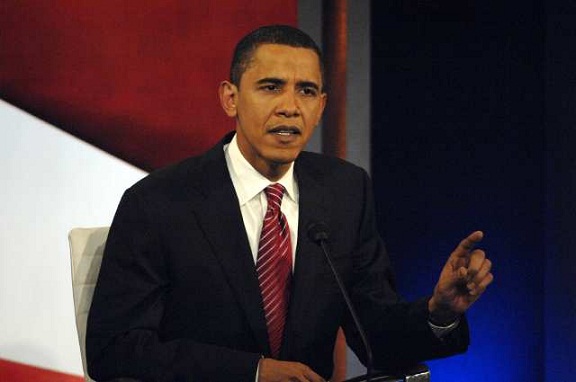
President Obama (Jan. 5, 2008)
(Donna Svennevik / ABC )
Oct. 18, 2011
No arrests in L.A.
#OccupyLA
Unlike its counterparts in other major cities, the Occupy L.A. movement, entering its 18th day outside City Hall, has not led to any arrests.
Demonstrators outside L.A. City Hall.
(Rick Loomis / Los Angeles Times)
Oct. 18, 2011
Public still undecided
Media response
Despite the growing effect of the movement, Americans are far more likely to blame their economic woes on the federal government than on major financial institutions, according to a USA TODAY/Gallup Poll.
Part of the difficulty in understanding the Occupy protests is that fewer people than usual are following the story in the media: 56% said they are following the story closely, which is below the averages for more than 200 news events Gallup says it has tracked since the 1990s.
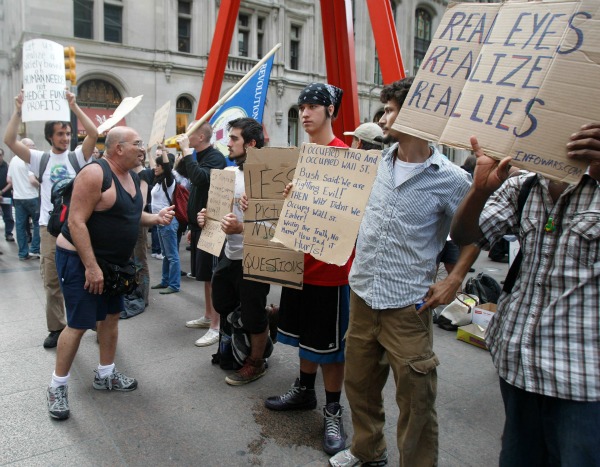
Occupy Wall Street demonstrators at Zuccotti Park in New York as the protest moves into its second month.
(Kathy Willens / Associated Press)
Oct. 18, 2011
MTV takes notice
Media response
The producers of MTV's "The Real World" seem to be taking notice of the recent protests and post a casting call on Craigslist:
"MTV's Real World is seeking cast members to tell their unique stories on our show. If you are over the age of 20 and appear to be between the ages of 20-24, and the description below sounds like you, we want to hear from you!
Are you a part of the OCCUPY WALL STREET movement?
If so, please contact realworldcasting@bunim-murray.com. Your subject heading should be YOUR NAME and WALL STREET."
Oct. 18, 2011
How long can this last?
#OccupyLA
Occupations across the country pose staggering logistical problems . Large numbers of people must be fed and kept reasonably warm and dry. Trash has to be removed; medical care and rudimentary security provided.
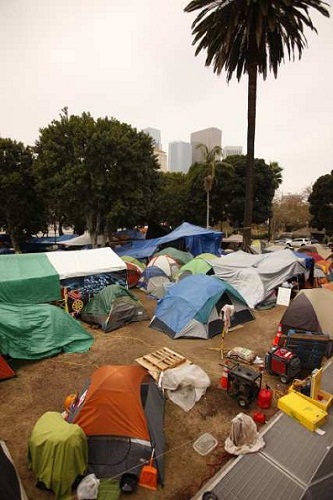
Even in Los Angeles, where city leaders have greeted the demonstrators warmly, there are signs of protest fatigue. For three weeks, city crews have been unable to maintain the two acres of grass and the tile walkways surrounding City Hall. Officials and protesters alike are beginning to wonder about the future: What happens next?
For weeks, city crews have been unable to maintain the two acres of grass surrounding City Hall, officials say.
(Al Seib / Los Angeles Times)
Oct. 18, 2011
Expansion talks
#OccupyLA
Occupy L.A. protesters discuss ideas to expand their demonstration to another downtown city property, but the plan falls through.
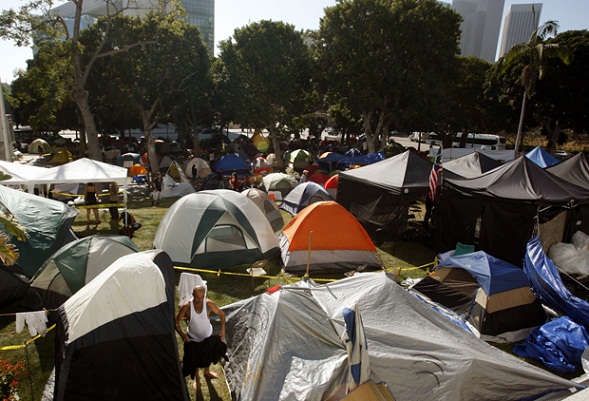
Demonstrators say about 700 people now stay outside City Hall each night -- including a sizable homeless population -- and there isn’t room for many more.
The city has already incurred $45,000 in costs related to the demonstration, including thousands of dollars in overtime pay for police. City officials say that reviving the trampled lawn can cost the city as much as $400,000 .
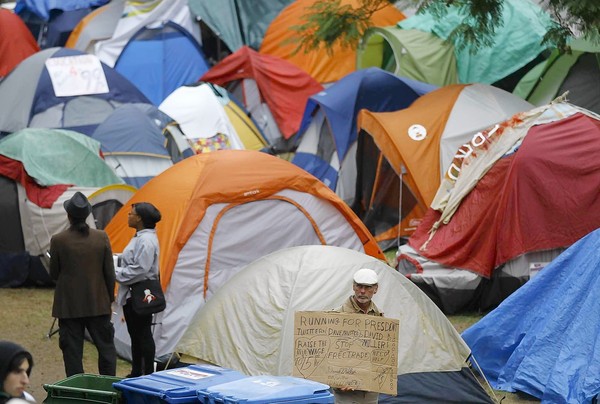
The Occupy L.A. encampment fills the City Hall lawn in downtown Los Angeles.
(Genaro Molina / Los Angeles Times)
Oct. 21, 2011
'We Shall Overcome'
#OWS
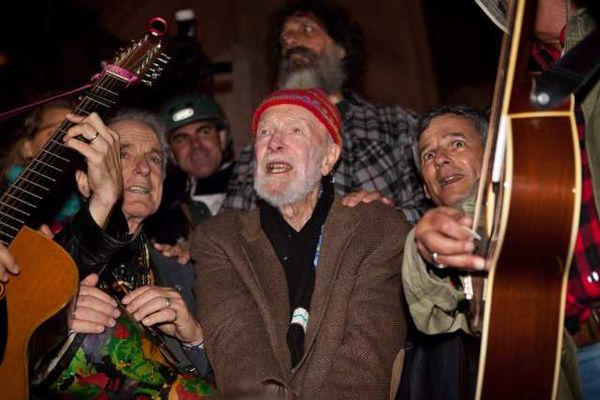
Folk music legend Pete Seeger, 92, leads Occupy Wall Street protesters in song, including "We Shall Overcome," which he popularized in the 1960s along with other singers.
Seeger has been a figure in just about every major antiwar protest movement in the last 50 years and has fought for racial and economic equality.
Pete Seeger iss accompanied by his grandson, Tao Rodriguez-Seeger, and Arlo Guthrie, Tom Chapin and David Amram.
(John Minchillo / Associated Press)
Oct. 25, 2011
The student angle
Followers
For almost a week, college student Nate Grant has sat cross-legged on a wall at the Occupy Wall Street encampment, holding a cardboard sign that bears his scrawled grievance: "Students Ought Not Be a Means of Profit."
Many other students have also joined the nationwide protests. With the nation's student loan debt approaching $1 trillion, the issue has become a subtext in all the chanting and marching.
Nate Grant, 22, of New Jersey.
(Carolyn Cole / Los Angeles Times)
Oct. 26, 2011
The beginning of the end?
The world
A predawn raid in Oakland jolts the nation.
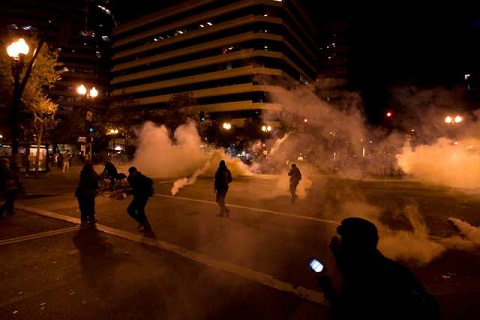
Police clash with hundreds of protesters, using tear gas to dislodge an encampment. Police make more than 100 arrests and say they were forced to use tear gas after officers were pelted by bottles, rocks and paint.
Leaders around the country say they don’t want a repeat of Oakland’s chaos, which has sparked angry protesters to return to the area . But officials are unclear how they will oust protesters who refuse to leave.
Police use tear gas to disperse Occupy Oakland protesters.
(Darryl Bush / Associated Press)
Oct. 27, 2011
Eviction talk
#OWS
Seeking more peaceful strategies, officials begin to talk openly of moving protesters out of their encampments in parks and public squares around the country.
Even as the weather gets colder , protesters show no signs of closing shop.
All told, there have been an estimated 1,500 to 2,000 arrests in dozens of American cities since the Occupy movement began.
Oct. 31, 2011
In Iowa
The world
Occupy Iowa votes to “occupy” Iowa caucuses -- an effort to shut down the Iowa campaign headquarters of presidential candidates until the state’s caucus day, Jan. 3.
Two months later , demonstrators converge on the headquarters of the Iowa Democratic Party after being denied access to the local campaign office for President Obama's reelection effort. Eight are arrested and charged with criminal trespassing.
Julie Brown, 34, is escorted by police from the Iowa Democratic Party headquarters in Des Moines. (Dec. 19, 2011)
(Michael J. Crumb / Associated Press)
Nov. 2, 2011
Support from the 1%
Followers
A new website, called "We are the 1 percent. We stand with the 99 percent," lets some of the wealthy 1% post photos declaring their support for the Occupy protesters in New York, Los Angeles and elsewhere.
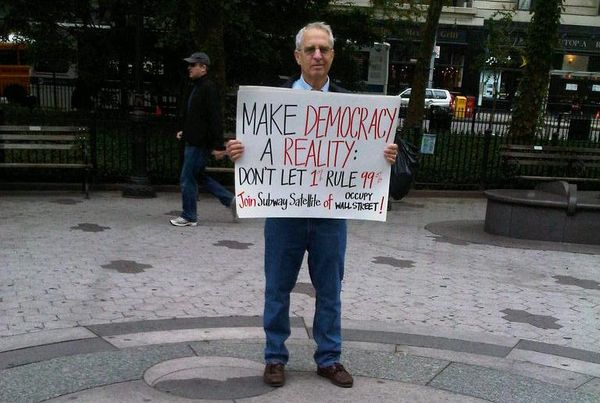
Bob Heller, 69 and retired after a career in corporate public relations, isn't about to throw up a tent downtown with the youngsters occupying Zuccotti Park. He says he is disgusted by the country's disparity in incomes and finds it his duty to hold a morning vigil at his neighborhood subway stop.
(Geraldine Baum / Los Angeles Times)
Nov. 4, 2011
Two arrests
#OccupyLA
Police are called to two violent incidents at Occupy L.A., adding to questions about the protest and its future.
One woman is charged with setting someone's clothes on fire, and another woman is accused of hitting a man with a tent pole.
Mayor Antonio Villaraigosa says the encampment "cannot continue indefinitely," citing health and safety concerns.
Nov. 5, 2011
Transfer march
#OccupyLA
Trying to build on momentum generated by the Occupy movement, hundreds of protesters march through downtown L.A.'s financial district to vent frustration with income inequality and Wall Street.
The demonstration is timed to coincide with Bank Transfer Day, a grass-roots drive to get people across the nation to move money from big banks into smaller banks or credit unions.
Occupy L.A. protesters have launched regular protests in the financial district since they first set up camp outside City Hall seven weeks ago.
(Getty Images)
Nov. 10, 2011
Media response
The Occupy encampments have drawn the interest of photographers and journalists from around the world.
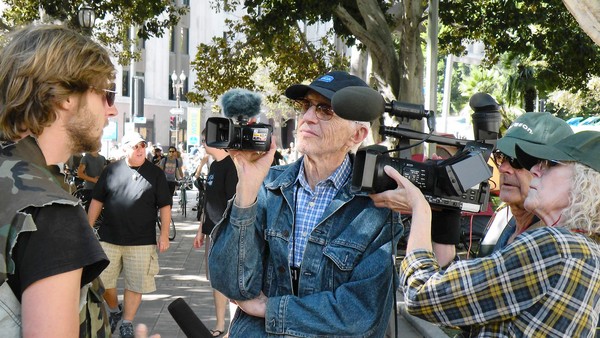
Haskell Wexler, a two-time Oscar-winning cinematographer, posts short documentary vignettes online about the people camped out in downtown Los Angeles.
Haskell Wexler, 89, at work filming. (Nov. 8, 2011)
(Rita Taggart / Los Angeles Times)
Nov. 12, 2011
The tone changes
The world
From New York to Oakland, Occupy camps have worn out their welcome, with crime, squalor and traffic blockades increasingly capturing more attention than the movement’s messages.
In Salt Lake City, police arrest 19 people when protesters refuse to leave a park a day after a man was found dead inside his tent at the encampment.
Hundreds of Occupy Wall Street protesters marched through the financial district trying to shut off access to the New York Stock Exchange and major banks.
(Carolyn Cole / Los Angeles Times)
Nov. 13, 2011
In the Pacific Northwest
The world
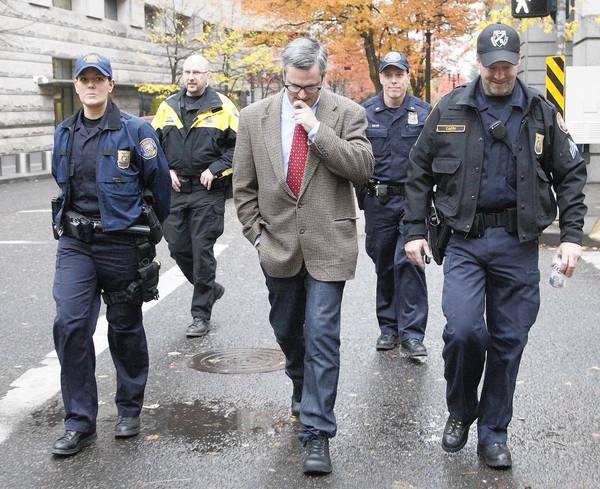
More than 50 protesters are arrested, but Portland Mayor Sam Adams manages to pull off possibly the cleanest Occupy eviction in the country so far -- no pepper spray, no rubber bullets.
The decision to close the camps was a tough call for Adams, whose sympathies are with the protesters. He orders the camps to be shut down due to unhealthy conditions and the increasing number of drug users and thieves.
Portland Mayor Sam Adams, flanked by police as he walks to City Hall. (Nov. 14, 2011)
(Rick Bowmer / Associated Press)
Nov. 14, 2011
Occupy Oakland ending
The world
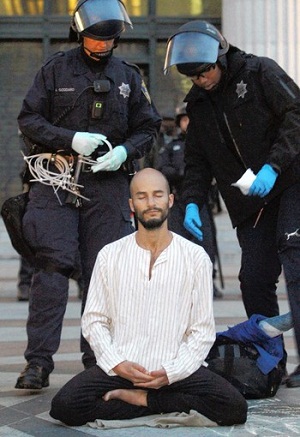
Just 12 hours after police dismantled a revived Occupy Oakland tent city in a peaceful predawn raid, about 700 protesters return to the civic center plaza, vowing to keep their movement alive but undecided about whether to defy police and retake the site of their monthlong protest.
A few days prior, , thousands of demonstrators chanted and marched in a daylong, peaceful strike.
A protester meditates as police move to arrest him at Occupy Oakland. (Nov. 14, 2011)
(Matthew Sumner / Getty Images)
Nov. 15, 2011
Evicting Occupy Wall Street
#OWS
A surprise police raid at 1 a.m. clears the Zuccotti Park encampment, seizing even the protesters’ tents, kitchen gear, generators and personal belongings.
Even die-hard demonstrators acknowledge that the surprise post-midnight raid is a logistical setback that could force the movement to find a new home.
Mayor Michael Bloomberg says this does not violate freedom of speech and assembly rights, citing the health and safety conditions in the park as reasons for the eviction.
Nov. 15, 2011
On college campuses
Followers
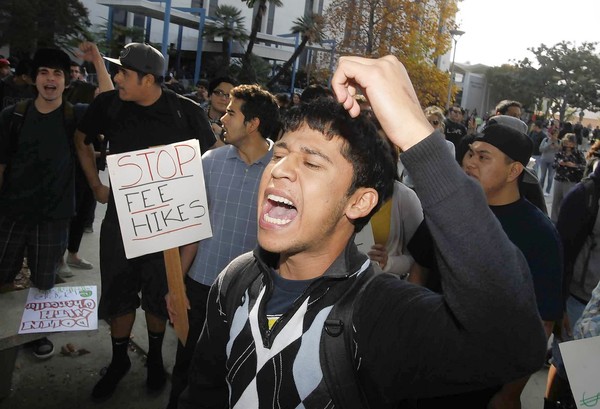
Rallies are held at University of California and California State University campuses in shows of continued support for the Occupy Wall Street movement and discontent over education cuts and tuition hikes. UC Berkeley is the largest event, with more than 1,200 students and faculty members.
The Occupy movement spreads to many other college campuses, including Harvard University and the City University of New York.
Cal State Fullerton sophomore Claudio Soria leads fellow students in a protest of tuition hikes. (Nov. 15, 2011)
(Mark Boster / Los Angeles Times)
Nov. 16, 2011
Bank occupied
The world
Protesters seize a Bank of America branch in San Francisco's financial district, a demonstration that forces jittery customers and employees to flee and leads to almost 100 arrests.
It takes about 40 police officers in riot gear nearly four hours to clear the bank, but no one is injured.
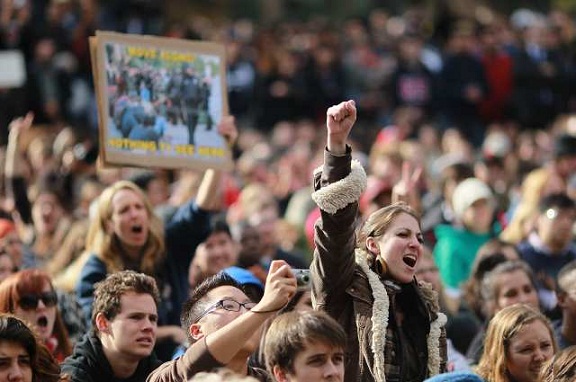
Many of the protesters include UC Berkeley and UC Santa Cruz students, who joined Occupy San Francisco demonstrators to denounce bank bailouts and tuition increases.
A student pumps her fist during a demonstration at UC Davis. (Nov. 21, 2011)
(Getty Images)
Nov. 17, 2011
More arrests
#OccupyLA
In Los Angeles, police arrest 72 Occupy L.A. protesters, including some who had set up tents in the middle of a busy downtown thoroughfare.
In Manhattan, where protesters were evicted earlier this week, at least 200 people are arrested, and several police officers and protesters are injured as demonstrators march across the Brooklyn Bridge to mark the movement’s two-month anniversary.
VIDEO
Members of the Occupy Los Angeles movement face off with police officers during a march through downtown L.A. (Dec. 3, 2011)
(Genaro Molina / Los Angeles Times )
Nov. 20, 2011
Outrage at UC Davis
Followers
UC President Mark G. Yudof orders an urgent review of use of force and security practices after two UC Davis officers use pepper spray on nonviolent student protesters.
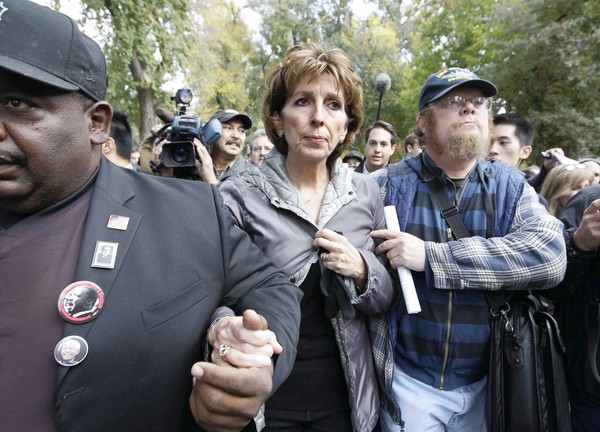
As outrage mounts over campus police's use of the chemical against seated, nonviolent protesters, UC Davis Chancellor Linda Katehi tells more than 1,000 students and faculty members she feels "horrible for what happened."
Linda Katehi is escorted from a small stage in the campus quad after she apologized to more than 1,000 students and faculty members.
(Paul Sakuma / Associated Press)
Nov. 22, 2011
Negotiations
#OccupyLA
Los Angeles officials offer Occupy L.A. protesters a package of incentives that includes downtown office space and farmland in an attempt to persuade them to abandon their camp outside of City Hall, according to several demonstrators who have been in negotiations with the city.
Officials say they do not want the demonstration to end violently and have steered away from police raids like those in New York, Oakland and other cities. Los Angeles remains one of the most accommodating cities in the nation for its Occupy encampment.
Los Angeles police officers count tents at City Hall. (Nov. 28, 2011)
(Barbara Davidson / Los Angeles Times)
Nov. 23, 2011
The occupations' costs
Media response
During the first two months of the nationwide Occupy protests, the movement has cost local taxpayers at least $13 million in police overtime and other municipal services, according to a survey by the Associated Press .
Occupy L.A.'s encampment has cost the city at least $2.35 million, not counting repairs to the lawn and fountain outside City Hall, according to city officials . The Los Angeles Police Department has spent an estimated $1.2 million on overtime.
More than $1.7 million will be added to the city's growing pool of red ink in this year's budget.
(Robert Gauthier / Los Angeles Times)
Nov. 26, 2011
Deadline
#OccupyLA
Los Angeles Mayor Antonio Villaraigosa, reads a letter addressed to Occupy L.A., announcing a deadline to shut down the City Hall park.
When Occupy protesters set up camp on the City Hall lawn seven weeks ago, city officials went out of their way to welcome them. But concerns about damage to the lawn and public health and safety risks have turned them against those camped outside.
The movement is now at a crossroads, the mayor says, with a choice of "spreading the message of economic equality" or defending "a particular patch of earth."
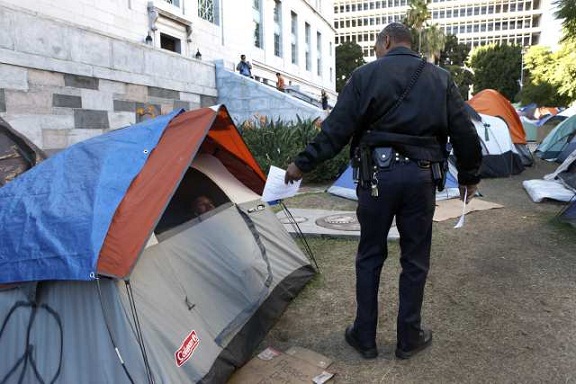
A general services officer hands out fliers letting Occupy L.A. campers know that they will no longer be allowed to stay overnight on the City Hall lawn. (Nov. 26, 2011)
(Arkasha Stevenson / Los Angeles Times)
Nov. 27, 2011
Choices
#OccupyLA
As of Sunday, Nov. 27, Occupy L.A. is the nation's largest remaining around-the-clock outpost for the nationwide movement.
Activists and L.A. officials face difficult choices over the next phase of the movement as a 12:01 Monday deadline approaches for the departure of the nearly 700 protesters in the encampment on City Hall grounds.
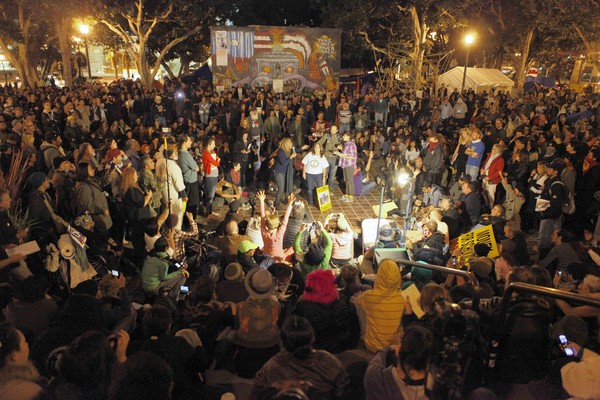
In anticipation of possible eviction early Monday by the LAPD, Occupy L.A. protesters hold an assembly in front of City Hall, where speakers urged fellow activists to “not be intimidated.” Many demonstrators announced their intention to stay put. (Nov. 27, 2011)
(Arkasha Stevenson / Los Angeles Times)
Nov. 29, 2011
Eviction
#OccupyLA
In the hours leading up to the mayor's deadline, Occupy L.A. protesters vow to maintain a nonviolent posture.
About 1,400 police officers in riot gear swarm at 12:13 a.m. Two minutes later, it is effectively over.
Although police spend hours clearing the area, there is never a fight for control of the park. By 4 a.m., the last tree-sitting protester is removed. In all, 292 are sent to jail.
Panorama: Occupy L.A. before and after
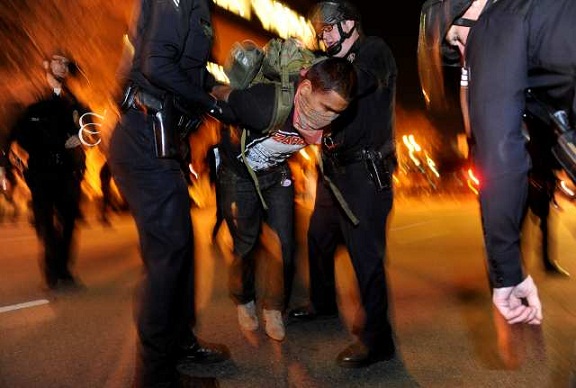
LAPD officers arrest an Occupy L.A. protester. (Nov. 30, 2011)
(Wally Skalij / Los Angeles Times)
Dec. 1, 2011
Declaring a new beginning
The world
The end of the Los Angeles camp -- and the Occupy Philadelphia site, which was dismantled the same night -- could signal the end of public encampments as the Occupy movement's primary tactic.
But organizers and their supporters from labor, religious and immigrant rights groups say that closing the camps won't stop the movement's momentum.
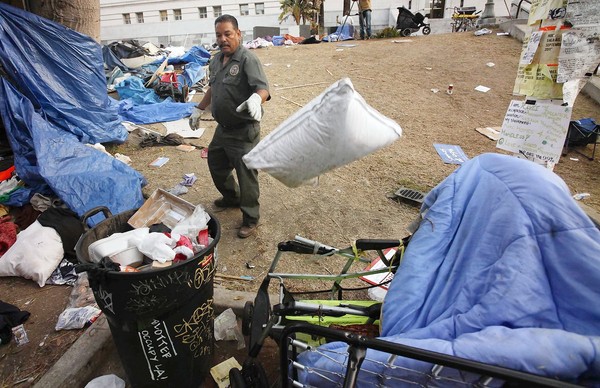
Sanitation worker Gino Ramirez starts clearing the debris left behind after the eviction of Occupy L.A. protesters. (Nov. 30, 2011)
(Al Seib / Los Angeles Times)
Dec. 3, 2011
Arrestees released
#OccupyLA
Most of the almost 200 who had remained in jails are freed three days after the eviction because they had no previous criminal record. They share experiences and talk of what the group might do next.
They initially faced a minimum bail of $5,000, and about 40 had been bailed out the day before.
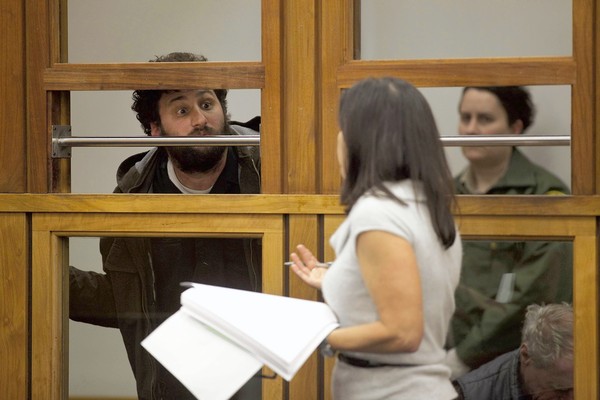
John Doe II, who was arrested during the Occupy L.A. raid, attempts to get a last word in with deputy public defender Carrie Miner as she defends him in Los Angeles' Central Arraignment Court. He was released with no charges.
(Arkasha Stevenson / Los Angeles Times )
Dec. 6, 2011
Lending practices
Political response
Under pressure from Occupy L.A. activists and others seeking ambitious reforms of lending practices, the City Council begins to debate a proposal that would hold banks more accountable by exposing their lending records to public scrutiny.
Officials describe it as an attempt to strike a compromise between the banks and community activists.
Occupy L.A. activists march toward City Hall to attend the budget and finance committee meeting after a rally supporting reforms in the city's banking laws. (Dec. 5, 2011)
(Mel Melcon / Los Angeles Times)
Dec. 6, 2011
Demonstrations at foreclosed homes
#OccupyLA
Chased from their encampments across the nation, protesters are now staging demonstrations at foreclosed homes in nearly two dozen states to draw attention to the effect of the housing collapse on American families.
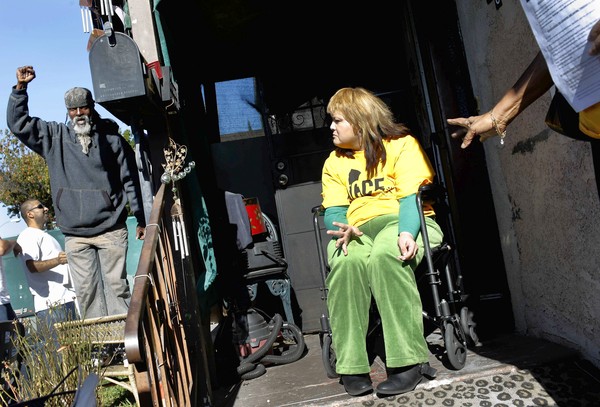
Dozens of protesters gather at the South Gate home of Ana Casas Wilson, right, who faces eviction. (Dec. 6, 2011)
(Michael Robinson Chavez / Los Angeles Times)
Dec. 7, 2011
Occupy San Francisco evicted
The world
Police clear the Occupy San Francisco camp, arresting 70 protesters. In Boston, protesters lose legal protection against eviction and are cleared out of Dewey Square by the end of the week.
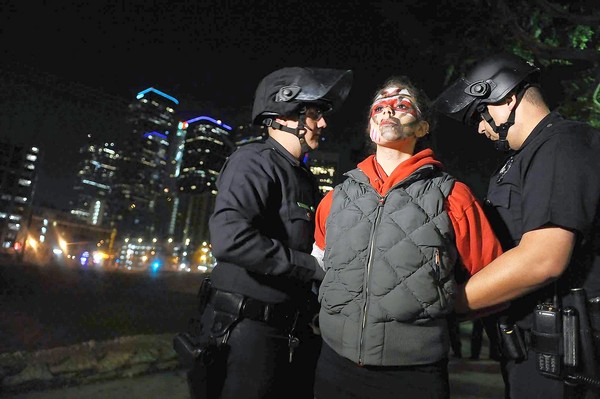
Los Angeles police officers arrest an Occupy L.A. protester near the City Hall encampment. (Nov. 30, 2011)
(Wally Skalij / Los Angeles Times)
Dec. 12, 2011
Port protests
The world
Thousands of Occupy Wall Street protesters block access to several major West Coast ports in synchronized demonstrations that slow business but fall short of what some protesters hoped would be a complete shutdown of coastal shipping.
The protests stretch from San Diego to Anchorage, bring work to a standstill in Oakland and Longview, Wash., and lead to the closure of a major marine terminal in Portland, Ore. Demonstrators cause smaller disruptions in Seattle and in Long Beach .
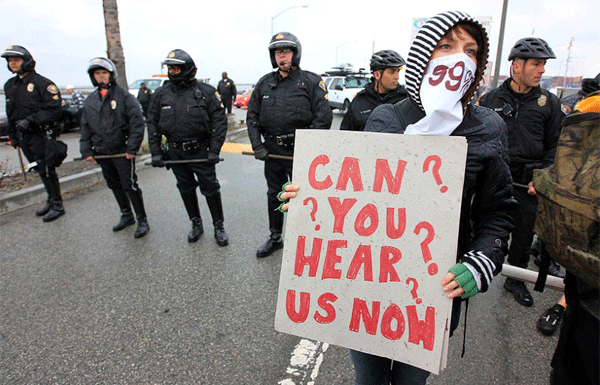
A protester stands in front of police at the Port of Long Beach early in the morning.
(Los Angeles Times)
Dec. 15, 2011
Next steps
The world
Occupy supporters are claiming credit for at least one political accomplishment” : elevating the issue of income inequality to the top of the national conversation.
In California, Occupy protesters continue to adopt the movement’s ideologies -- occupying banks and even inspiring a re-imagined script for Charles Dickens’ “A Christmas Carol.” Looking for a high-profile venue since their camps were removed, activists take aim at the Rose Parade in the new year.
"You can't evict an idea," one protestor says.
Full coverage »
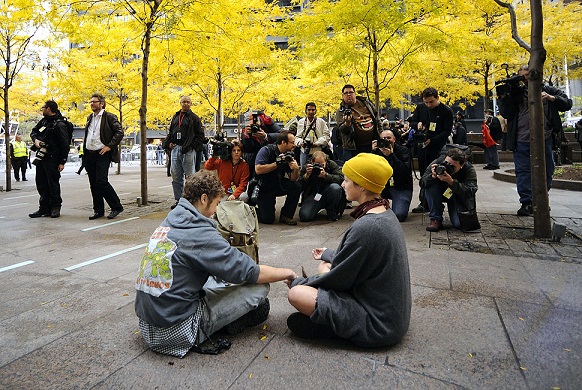
People meditate in Zuccotti Park after police remove hundreds of Occupy Wall Street demonstrators.
(Peter Foley / Bloomberg)