| Dec. 17, 2010 |
|
|
At 11:30am, Mohamed Bouazizi, a 26-year-old street vendor, sets himself on fire in Sidi Bouzid to protest the seizure of his wares by police and their subsequent refusal to accept his complaints. Some reports indicate that protests began as soon as Bouazizi was taken to the hospital. |
|
| Dec. 18, 2010 |
|
|
A peaceful rally organized in Mohamed Bouazizi's memory ends in anger as police douse marchers with tear gas, inciting further protests over Bouazizi's treatment and the high unemployment in the country. The "Jasmine Revolution" begins. |
|
| Dec. 24, 2010 |
|
|
Police open fire at a rally in the city of Menzel Bouzaiene, killing an 18-year-old demonstrator and wounding 10 others. |
|
| Dec. 27, 2010 |
|
|
Protests reach the capital, Tunis. |
|
| Dec. 28, 2010 |
|
|
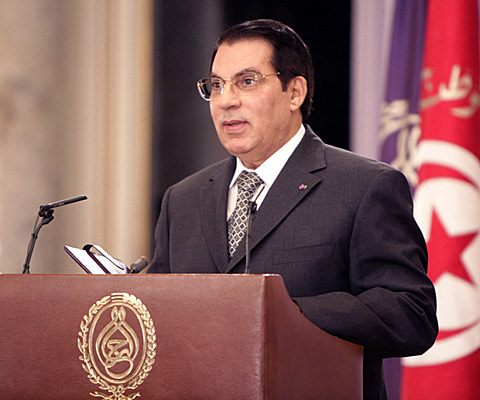
President Zine el Abidine ben Ali appears on television and warns of reprisals unless the protests halt immediately. He promises economic reforms to combat high unemployment.
|
 AFP/Getty Images President Zine el Abidine ben Ali in 2007. |
| Jan. 4, 2011 |
|
|
Mohamed Bouazizi dies. The next day more than 5,000 mourners reportedly attend his funeral. |
|
| Jan. 10, 2011 |
|
|
Violence intensifies as government snipers are deployed, bringing the death toll to 23 since the protests began, according to the government. The International Federation for Human Rights puts the number as high as 66. Protests have now spread across the nation. |
|
| Jan. 14, 2011 |
|
|
Bowing to pressure from protesters, President Zine el Abidine ben Ali declares Tunisia to be in a state of emergency and takes refuge in Saudi Arabia, leaving Prime Minister Mohamed Ghannouchi to assume control of the interim government. |
|
| Jan. 20, 2011 |
|
|
President Zine el Abidine ben Ali's ruling party, the Constitutional Democratic Rally (RCD), is dissolved, but many of its former members retain their cabinet posts.
|
|
| Jan. 24, 2011 |
|
|
Protesters take to the streets again in an effort to oust all former members of the Constitutional Democratic Rally (RCD) from the interim government, including Prime Minister Mohamed Ghannouchi. |
|
| Feb. 27, 2011 |
|
|
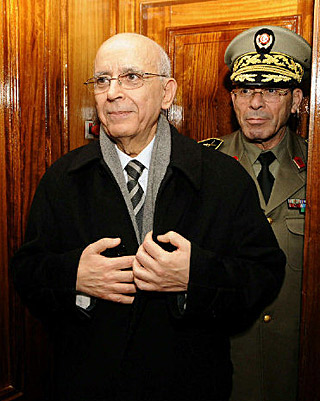
After more than a month of continued rallies and bloodshed, a crowd of more than 100,000 protesters force Prime Minister Mohamed Ghannouchi to resign. |
 Fethi Belaid / AFP/Getty Images Prime Minister Mohamed Ghannouchi, left, and General Rachid Ammar. |
| April 16, 2011 |
|
|
As Tunisia transitions from dictatorship to possible democracy, some make an effort to collect and preserve regime archives, very few of which have been made public. |
|
| Oct. 25, 2011 |
|
|
Amid indications that it would win more than 40% of the seats in an assembly, Tunisia's moderate Islamist party seeks to form a unity government.
|
|
| Dec. 13, 2011 |
|
|
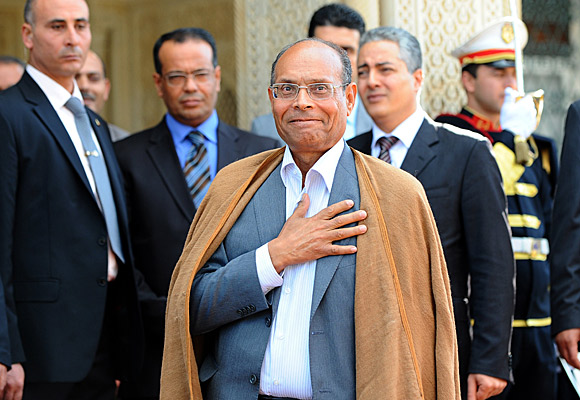
Veteran human rights activist Moncef Marzouki is sworn in as president of Tunisia.
|
 Fethi Belaid / AFP/Getty Images Moncef Marzouki in Tunis. |